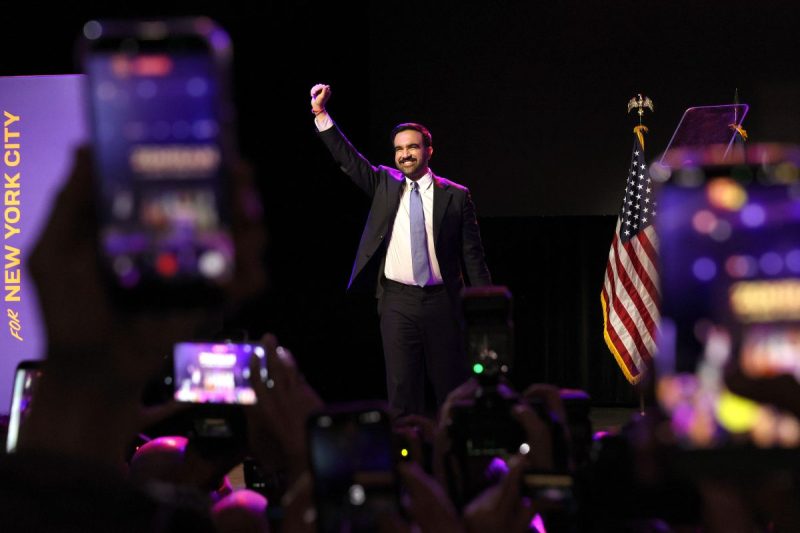
Mamdani has managed to block the rent increase for almost half of New York’s homes for at least a year.
"A historic victory for the tenants of New York," the mayor commented on the decision, formalized by the vote of the Rent Guidelines Board.

There have been thirty-five arrests following the violence of recent weeks. While the police try to identify other suspects and 20,000 people take to the streets against racism, life has become hell for immigrants and minorities in the city.
According to NHS protocols, the British national health service, nurses should wear their uniforms only upon arriving at the hospital and take them off when leaving. It is a hygiene rule that Chinonso, a Nigerian nurse living in Belfast, breaks for a specific reason: it is the only way she feels safe during her commute. Or rather, it was the only way, because, as she tells me, even that has not helped.
“I thought that if they saw I was a nurse, they would leave me alone.” She refers to the protesters – or terrorists, as they should rightly be called – who have been wreaking havoc in Belfast and other areas of Northern Ireland for a week. Chinonso arrived in the UK five years ago, during Covid, in the early post-Brexit period, when the NHS was suffering, in addition to the effects of the pandemic, from the departure of numerous European workers. “Anyone with a criminal record will never be able to work for the NHS; the checks are extremely strict,” she says to explain why that uniform made her feel safer on the bus. The rioters are hunting for criminals, for immigrants who threaten the safety of the Irish. Or so they say. According to this logic, a nurse can never be one of their victims.
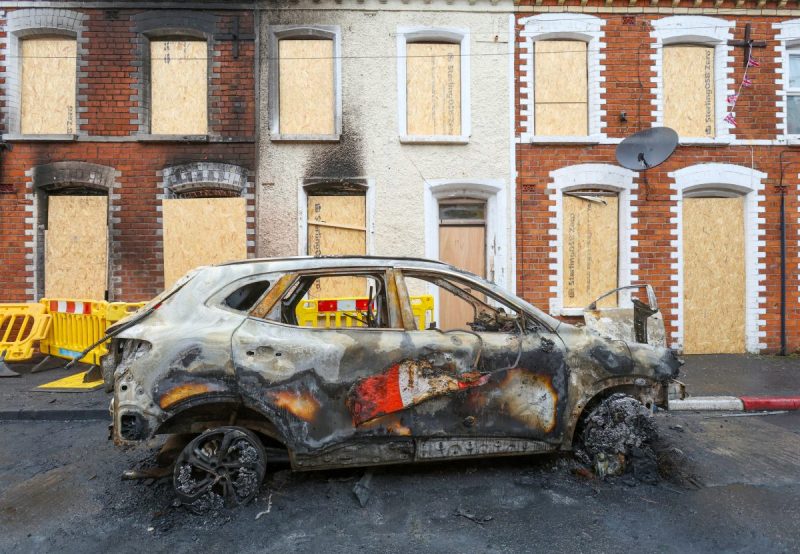
It all started with a stabbing that occurred on June 8 in Belfast: a 44-year-old man, Stephen Ogilvie, was seriously injured and hospitalized with injuries that caused him to lose an eye. A 30-year-old Sudanese citizen, who entered Northern Ireland through the Republic of Ireland, has been charged with attempted murder. From that moment on, East Belfast exploded. Houses and cars were set on fire, shops and businesses run by ethnic minorities were looted and burned, and neighborhoods with immigrant presence became the target of an organized hunt. Then the violence spread to other neighborhoods and outside the city limits.
A manhunt has effectively begun, based on the idea that immigrants pose a risk to the safety of citizens, despite there being no data showing a higher crime rate among immigrants than among the Irish. If the intention is to hunt down dangerous criminals, what does a nurse, who by her job cannot have a criminal record, have to do with it? As you may have guessed, wearing the uniform has not spared Chinonso from various episodes of racial violence, the latest of which occurred just a few days ago while she was returning home from her shift still in uniform. She was hit in the head with a stone by a group of anti-immigration protesters.
“There is only one bus I can take to get to work. I don’t drive, and walking there is out of the question. Today I’m getting help from my colleagues, who are picking me up and bringing me back. There is no safety for us; that is the truth,” she recounts with a trembling voice. After years of abuse, she now wonders if it is worth staying: it is a painful decision, she says, especially because it was her sister, already a nurse in Belfast before her, who convinced her to come live here. Chinonso points out, with a rhetorical question and disconcerting bitterness: if people like her left Northern Ireland, who would take care of the elderly Irish parents?
Chinonso’s story, in this sense, is not an exception. Another nurse was chased and intimidated by four hooded men while going to work at the Ulster Hospital in Dundonald: despite the assault, she insisted on doing her shift. The Unison union reported that foreign healthcare workers have been followed home, with letters slipped under doors threatening them to leave “or end up burned,” and staff who are afraid to leave their homes and stock up on food.
“We have had to find temporary accommodations for many healthcare professionals,” Imani Strong, deputy director of the North West Migrants Forum, an organization based in Derry that provides legal, health, and social assistance to migrant and ethnic minority communities in the northwest of Northern Ireland, tells me. In recent days, the Forum has been assisting and raising funds for those forced to leave their homes, for those who cannot leave home, go to work, or go to school.
“If the government does not intend to do something in the long term,” she tells me with a noticeable but admirably controlled anger, “then it should at least establish a fund so that people can afford to move on with their lives when situations like this occur.” In short, this is not the first time. “Every summer there are riots and violence of this kind, and people are forced to leave their homes, their lives. I see children who are afraid to go to school because their classmate might have participated in the protests. I see shop owners who do not want to open their businesses for fear of putting employees and customers at risk.”
To this, there is another, more recent weapon: flyers generated with artificial intelligence, which mimic official communications from the authorities, announcing road or shop closures that have never actually been decided. They are fake, but their sole purpose, to terrorize, is still achieved, because those running a business or a school prefer not to take risks. And the lives of hundreds of people come to a standstill. The most chilling thing Imani tells me relates to the atmosphere during the protests. “This is the account of a colleague of mine,” she specifies, explaining that she, as a black woman, could never approach those areas. “It almost feels like being at a festival. There are families with children. Everyone is there laughing and having fun until the violence starts, the attacks.”
Bringing children to such a demonstration, if we want to call it that, is, besides being a symptom of a parenting philosophy that is nothing short of questionable, also illegal: it constitutes “child endangerment,” Imani explains to me. Videos show very young kids behind black balaclavas and hoods. “I am convinced that many of these young people participate because it is a way to spend the evening, something to do.” Whatever the motivations of these kids, the fact remains that they are not the ones orchestrating all this. James McCarthy, a reporter for Belfast Live, is keen to specify: “The paramilitary forces, which are thought to have orchestrated all this, are also heavily involved in drug trafficking.” There is a line that runs between substance abuse, large groups of young people from areas with low public investment, a festival-like atmosphere, and the fact that this type of unrest always happens in the summer. “As soon as a migrant, or someone perceived as such, commits a crime, hell breaks loose. It happens every summer,” Imani repeats. “These are horrible crimes, but no one mobilizes when an Irish person, or a white person, commits a crime.”
Is there something different this time?, I ask her, alluding to the fact that, unlike usual, this story has made headlines around the world. “It’s like the other times, but bigger.”
What makes this wave more frightening is its scale. It is no longer violence that arises from below, from the indignation of marginalized working-class communities: it is instigated, amplified, and orchestrated by a global far-right network, with enormous resources and industrial-level organizational capacity, that instrumentalizes this anger. After the stabbing of Stephen Ogilvie, Tommy Robinson, a prominent figure of the English and global far right, wrote on social media: “Once again, the attack of an invader on our people,” urging the entire UK to take to the streets. Elon Musk responded by writing that “only by protesting repeatedly and loudly will anything change,” a post viewed over 7 million times.
McCarthy tells me that young people from Belfast have flooded the streets, but also many people from outside, likely responding to this sort of “call to arms” via social media. “The attacks are not random,” he tells me. For months, lists of HMOs, houses in multiple occupation, have been circulating, where the groups behind these violent acts believe migrants might live. Both the groups and their activities of collecting sensitive data on immigrants had been reported to the authorities months ago by the Accountability Project Northern Ireland.
“Then they storm hotels where asylum seekers live, shouting all kinds of threats and racist insults at those inside and anyone who gets in the way,” he tells me, saying he was attacked while filming one of these protests for an article. Among the collateral victims of this strategy are also lists with names and addresses of presumed immigrants, often mixed with addresses of Irish and students living in the same areas, as explained to me by Raied Al Wazzan, a doctor of Iraqi origin and a member of the Belfast Islamic Centre, who has lived in Belfast since 1990.
“I know many students who live in these houses in multiple occupation (with roommates, to be clear), many of whom are also Irish, English, who have had to leave because they were afraid their address was on one of these lists.” Lists that, by the way, had been known to the police for months, as noted by the Guardian.
A week after the start of this latest wave of violence, about 200 families have been evacuated, and among those forced from their homes were also infants. Dozens of people have been left homeless after rioters went door to door attacking foreign citizens, burning their homes.
Among the protesters are kids who do not seem to be older than twelve or thirteen. “It’s hard to determine an age because they are all masked,” Imani tells me, “but the fact remains that they are not just kids. On the fringes of the clashes, there are adults encouraging them. And now that the first arrests have been made, we can actually establish that they are not just kids, but adult men.” The boys, the children, are essentially put on the front lines and blamed for the clashes.
But the perpetrators of this guerrilla warfare are multiple: “I have heard it described as a rogues gallery (a lineup of criminals, ed.)”, explains Allan Preston, a journalist for The Irish News. “There are paramilitary groups” – the police have said they currently have no evidence to claim they are directing the violence, although most people I spoke to seem to take their involvement for granted – “there are spontaneous groups that take names like ‘concerned parents’ and amplify any news that comes across their radar, and then there are Tommy Robinson and Elon Musk throwing gasoline on the fire.”
What global far-right figures likely do not consider, or perhaps consider all too well, is that Belfast, due to its history, is a city built with particularly flammable material. A city that has experienced firsthand what it means to be divided, what it means for entire communities to be “burned out” of their homes for their identity.
Matthew O’Toole, an SDLP MP and leader of the opposition in the Northern Ireland Assembly, has described these episodes as racist pogroms. Allan Preston draws a parallel between what is happening today and the Troubles. In places accustomed to political violence, it is easier for new violence to emerge. “Our problem for decades has been sectarianism, especially in the working class: the loyalist-unionist front against the nationalist one. And sectarianism is easily transferable to racism. These groups have been taught to fear the other, the different. Once it was Catholics, now it is immigrants.” O’Toole has a more optimistic view, precisely because of his country’s past. He says his only hope is that the people in those areas of Belfast, who know what it means to be pushed toward violence because they have seen and lived it firsthand, have learned the lesson and do not want to fall back into it.
Yet there is another Belfast. “The march on Saturday in front of Belfast City Hall was extremely positive,” says Raied. “Twenty thousand people came out to say no to racism and that immigrants are welcome: this is the Belfast I know, the one I chose to live in. Most people are open, supportive, welcoming, and it is only a minority that carries out these violent and uncivil actions.” A minority, certainly. But capable of bringing an entire city to its knees.
Behind the anti-immigration rhetoric lies the textbook definition of a war among the poor. The areas of Belfast most affected by these riots are the same ones that have suffered the most from the deindustrialization of the 1980s and 1990s, the Thatcherite austerity policies, and those following the 2008 crisis. They are also the areas that, in recent years, have seen an increase in the migrant population, partly as a consequence of Brexit and the decline of European workers in sectors like healthcare, which heavily relies on foreign labor.
The numbers remain very low, however. According to the 2022 census, only 3.4 percent of the population of Northern Ireland, just over 65,000 people out of 1.9 million, belong to an ethnic minority, and of that total population, only 2,379 people are asylum seekers. “It is important to remember that this violence occurs in areas that have seen very little or no investment in social housing and public services,” explains James McCarthy. He describes it as misplaced anger, anger directed at the wrong target. “These places have seen investments from housing giants that have bought entire buildings, then used them to house asylum seekers, in areas that are already suffering from a deep housing crisis.”
The result is a white working class, impoverished and angry, pitted against the new working class made up of immigrants and their descendants. Two groups pushed against each other by powerful actors who do not aim to achieve better management of migration flows, or any other specific policy, and who generate enormous profits from shared online anger.
This is not an isolated phenomenon. Similar episodes occurred in Southampton last week, after the murder of a young man named Henry Nowak by Vickrum Digwa, an English citizen of Indian origin and Sikh faith. Nigel Farage, leader of Reform UK, incited the riots by saying that the English should respond with “pure anger.” Other clashes spread to Glasgow that same weekend. All these riots have in common the involvement of the same powerful and exposed figures of the far right.
By next week, it is easy to predict, Robinson, Musk, and Farage will already be talking about the next attack, the next protest, the next event capable of heating up emotions and angering their followers. But the incendiary positions they have taken, the minds of young people they have influenced, the misinformation they have circulated, those remain. And so do the terror and trauma of thousands of people who do not feel safe in the city where they live. In many cases, the cities where they were born.