Balenciaga loves Substack so much that it has become the first fashion house to partner with it.
The house has been using the platform for some time: there it announced the arrival of Piccioli and also streams the fashion shows live.

Domitilla Dardi states in her book Sewing Universes, citing examples of designer architects and mathematicians who changed the world, starting from needle and thread.
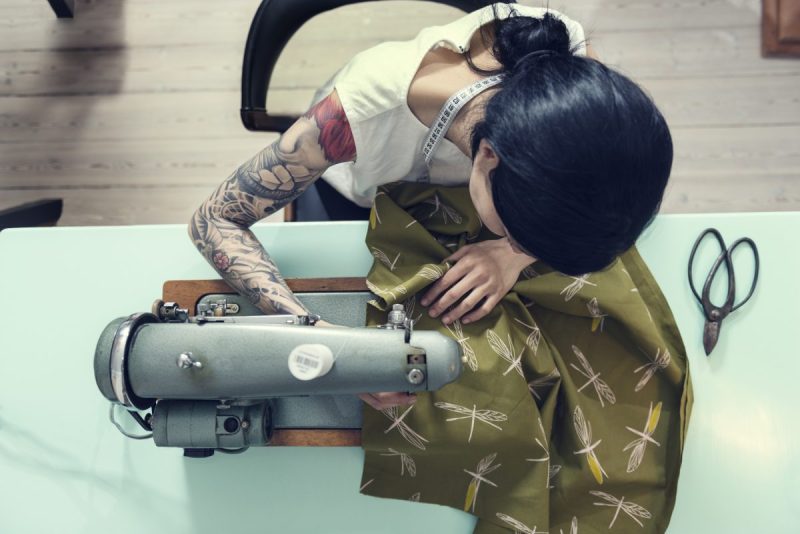
Ernest Thesiger was a British theatrical actor of Shakespearean tradition, one of those whose presence inspired a certain reverential fear (and indeed he would later establish himself in cinema primarily through horror, as when he played Dr. Pretorius in Frankenstein’s Bride by James Whale in 1935). Between one tour of Hamlet and another, cameras captured him backstage, busy with embroidery, a pastime he continued even after World War I, proposing to the British Ministry of Pensions to establish an embroidery workshop to provide training and work for disabled veterans. Fast forward to 2021 at the Tokyo Olympics: English diver Tom Daley, sitting in the stands waiting for his turn, wearing a mandatory mask, is knitting.
Despite nearly a century separating these events, in both cases the press has proven to be far from progressive, with mockery and insinuations regarding the sexual orientation of those men who otherwise, according to their implications, could never find comfort, pleasure, or peace in an activity like needle and thread (blissfully forgetting that for centuries fishermen have daily repaired nets, essentially sewing, without being accused of a lack of masculinity). This is one of the many anecdotes that Domitilla Dardi recounts in her book Sewing Universes – Why Minor and Feminine Arts Do Not Exist, published by Einaudi. The title of the tome is quite explanatory regarding its objective, but it is surprising that it is not written by a fashion historian, but rather a design curator, co-founder of EDIT Napoli and responsible for the design area at MAXXI in Rome from 2007 to 2023. And it is from here that we start to interview her.
ⓢ Why such a passionate defense of the world of sewing and clothing creation comes from a professional who deals with design?
Perhaps because those who come from outside those universes have a virgin perspective, less conditioned. The research that led me to write this book began several years ago following small discoveries that ignited my curiosity, and my experience is quite demonstrative of what I recount. I fundamentally believe that making “species jumps” across disciplines benefits every art; for example, I think about how in recent years design has benefited from contact with sciences like anthropology or botanical biology, with authors like Stefano Mancuso. Sewing universes, as the title of the book prescribes, also means moving from one side to the other, to then notice different things compared to what we have always seen.
ⓢ And indeed in the book you cite manyexamples and historical cases in which sciences like mathematics or design itself have been inspired by the art of creating clothes or accessories, adopting their methodology in their field. So why does the stereotype that relegates fashion to “minor art” persist historically?
I believe the reason is that we are taught, from a young age, an art history strongly based on cultural ideologies rather than on real historical facts. If you go and study, you realize that until a few decades before the Middle Ages, there was a great fluidity between the arts, among which one could move freely, without prejudice. The break between major and minor arts comes in the Renaissance, and it is a historiographical position. Vasari’s Lives (the full title of the work is The Lives of the Most Excellent Architects, Painters, and Sculptors of Italy, from Cimabue to Our Times, a work by Giorgio Vasari from 1550, ed.) is precisely the emblem of this approach, which responded to a political system (the work itself is dedicated to Cosimo I de’Medici, ed.).
Breaking this distinction in modernity were the historical avant-gardes that experimented a lot in terms of technique: just think of Giacomo Balla. In his house in Rome, we found a treasure; for him, clothes were living sculptures, and with his daughters Elica and Luce, he would walk around a gray, bureaucratic neighborhood, bringing color to the landscape. For him, clothing had an almost landscape dimension, and he experimented in every direction: his entire house was completely covered in this sort of expanded decoration that knew no limits and went beyond frames and wainscoting. What I have tried to emphasize in the book is that techniques, all techniques and tools, are innocent: it is how we appropriate them and the purposes to which we assign them that are the result of a specific orientation. Today, looking at things in this light seems to me a necessary restitution and not merely a matter of scientific justice but of rediscovering the potential of techniques that can be used in areas different from those we know.
ⓢ What are the similarities, in this sense, between fashion design and design project?
Both design habitation, only in the case of fashion it is a body that inhabits a garment. As I mention in the book, it is no coincidence that in 1975 during a seminar called Designing on Myself, participants, who belong to the Cavart group, are invited to create a paper shirt, adhering to the motto “I wear a garment, I will wear a dwelling, I want to wear a project.” At the other end of creation from the shirt, a flat element that becomes three-dimensional through cutting and sewing, is the sari, a continuous plane that wraps everything. If we look at these two elements with eyes untainted by the prejudice of cultural heritage, we immediately realize that we are talking about the two great families of architecture. In this sense, I say that architecture has much to learn from fashion at the moment of design. I recently returned from my first trip to Japan, and one of the aspects that struck me the most was realizing how the kimono is the true Japanese architecture, more than the house or the imperial villa because it is a micro habitat, which is also what Nanni Strada supported with Il Manto and the skin (politubular garments with which he won the Compasso d’oro in 1979, treating fashion as a design discipline, ed.).
ⓢ The point you raise, however, that of feminine arts considered minor, has not only historical and political roots but even religious ones…
Of course, in The Craftsman by sociologist Richard Sennett, it is explained that at a certain point women were forced by the Church to use needle and thread because being the woman a temptress by definition, having free hands could allow her to indulge in licentiousness. Assimilating only the feminine world to sewing has erased a very important legacy because many men from different cultures saw nothing shameful in using needle and thread not only for fishing nets but also to produce caps that could be functional for economic gain. On the other hand, there is still a counter-discrimination; perhaps the most striking case is that of Rosey Grier, a symbol of machismo as a champion of American football who later became a bodyguard for the Kennedys. He protects Ethel Kennedy when Bob is assassinated and thus becomes a national hero: consequently, interest arises in his world and passions, among which is cross-stitch, on which he even wrote a book, and he recounts in the introduction how he convinced his poker buddies – another practice considered testosterone-fueled – to take breaks during games by teaching them cross-stitch as a psychosocial and therapeutic form of sharing. Today we are grown enough to overcome gender issues and realize that these techniques can be transformative in every sense.
Another stereotype to debunk: that being feminine practices and therefore “minor,” they cannot be classified as true sciences…
Mathematician Diana Taimina was the first to demonstrate the physical, not just theoretical, existence of the hyperbolic plane through crochet, to name one. None of her male colleagues succeeded. And the point is perhaps all here: in having the intelligence to systematize seemingly distant fields to solve problems, without prejudice.
ⓢ This book is a novelty and also a rarity in a publishing market like the Italian one, where despite the prominence of fashion, few theoretical studies on the subject, as well as essays, are written. Why do you think this happens?
This is a question I have asked myself as well, because when I studied to write the book, I found myself with many texts from the Anglo-Saxon area. The answer I gave myself is that there is a problem of education. Beyond those who enroll in fashion academies for practical outlets, this theoretical part could be cultivated in faculties of literature, art history, philosophy, anthropology, and so on. But these are institutions completely ensnared in a prejudicial system, still living off that discrimination between major and minor arts. So either one relies on exceptions, like Maria Luisa Frisa (a fashion historian who has recently published also for Einaudi The Body in Fashion, ed.) or it becomes difficult. We continue to sow, hoping that future generations will achieve the goal we have missed. Finally, without prejudice.