Every summer, the major film festivals in Cannes and Venice capture the world’s attention with premieres and stars. But away from the red carpets, between June and July, another very interesting and more discreet film festival takes place in the squares and cinemas of Bologna.
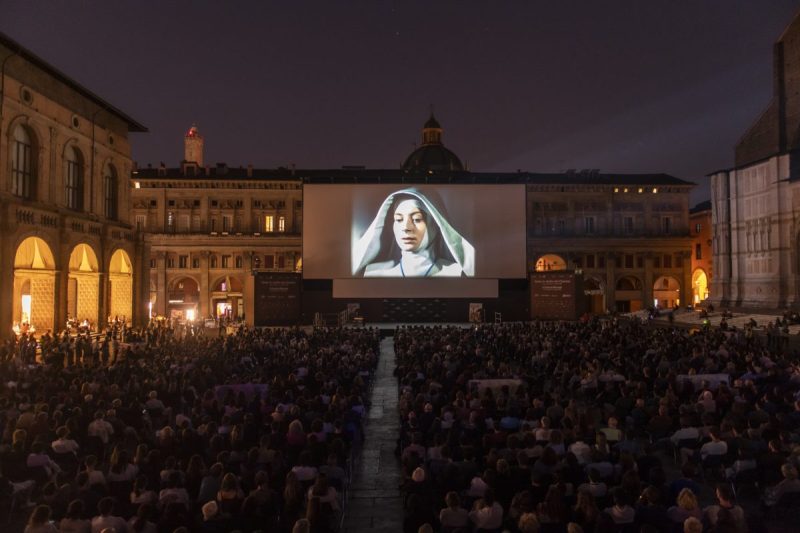
In Piazza Maggiore, in the medieval heart of the city, a gigantic screen measuring 23.5 meters wide and 10 meters high is installed. Under the starry sky, with the statue of the god Neptune watching the arriving audience, every evening more than four thousand spectators sit in a nearly sacredsilence, between the unfinished façade of the Basilica of San Petronio and the clock tower of Palazzo d’Accursio. It is one of the most famous locations of Il Cinema Ritrovato, the festival dedicated to the history of cinema and the activities of film archives. For Martin Scorsese “it is truly a unique festival.” And this year, from June 20 to 28, it celebrates its 40th edition. The festival is organized by the Fondazione Cineteca di Bologna – directed by Gian Luca Farinelli – a prominent international institution that preserves among its treasures the archives of Charlie Chaplin and Pier Paolo Pasolini. It is one of the most renowned film festivals in the world dedicated to classic, restored, rare, little-known, unreleased, or previously considered lost films that have been miraculously and tenaciously rediscovered. It attracts cinephiles, scholars, researchers, collectors, archivists, restorers, distributors, and cinema professionals. Many affectionately call it “The cinephile’s paradise,” echoing a phrase by Peter von Bagh, the festival’s historical artistic director.
Most film festivals primarily celebrate new releases; Sundance is a showcase for many films that streaming quickly absorbs. Il Cinema Ritrovato goes in the opposite direction, believing that a film from the last century can be more alive, more modern, and more necessary than the latest release, surprisingly relevant. It can explain this confusing present. And its ever-growing audience proves it right. People arrive in Bologna thinking they know the history of cinema and leave understanding that there is always something else to learn, with a desire to return. It demonstrates the importance of festivals built around rediscovery, rather than premieres: they do not dictate what to watch for the future; they show how much of the past has been forgotten.
A screen as big as a city
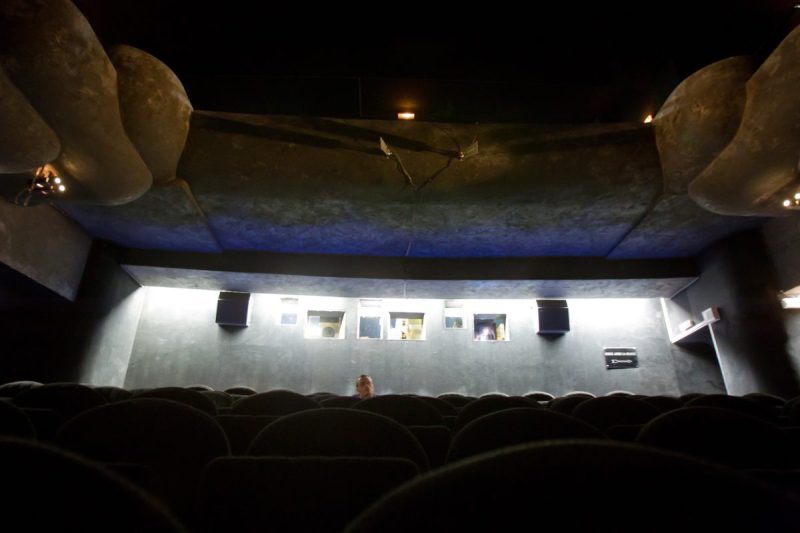
During Il Cinema Ritrovato, Bologna transforms into one large screen: the festival, in fact, extends throughout the city, animating eight venues, including the Cinema Modernissimo (a restored Art Nouveau underground gem) and Piazzetta Pasolini, with its 1940 projector with a carbon lamp. The locals call it La Nonna: when it turns on, it comes to life with a buzz, raising a beam of luminous steam towards the sky with a characteristic smell and giving spectators a sensory experience that takes them back to the dawn of cinema. There can be up to nearly fifty events and screenings per day, with up to five hundred films screened, and many events take place simultaneously in different locations.
Many expertsargue that the cinema experience in theaters is dying. There are data that support this pessimism, and it seems that global box office revenues will not return to pre-pandemic levels even by 2029. Bologna, perhaps, shows how to reverse this trend, this crisis: it satisfies the audience’s desire for a collective, live, unrepeatable viewing experience in a unique and evocative space – not on the couch at home or in an anonymous and identical theater – where you cannot pause, rewind, or watch at 1.5x speed. Bologna demonstrates that when cinema returns to being a ritual, theaters and squares fill up again. Indeed, as director Denis Villeneuve said “Since the dawn of time, humans have felt a deep need for collective storytelling experiences. Cinema on the big screen […] is an art form that unites people, celebrates humanity.”
Attendance, the variety of the audience, guests, and international collaborations clearly show that this festival is not a pilgrimage for cinephiles alone. Last year’s edition had over 170,000 spectators, with five thousand accredited from 57 nations, and more than 450 films on the program. Over the years, it has hosted some of the most important contemporary directors: Wim Wenders, Martin Scorsese, Wes Anderson, Damien Chazelle, Alexander Payne, Alice Rohrwacher, Asghar Farhadi, Jane Campion, and Terry Gilliam. Guests at Il Cinema Ritrovato are perceived as familiar: after speaking from the stage in Piazza Maggiore, they are easily approachable, as being outdoors, they have nowhere to escape to; they must leave somewhere.
Criterion, one of the most important distributors of classic films in high-quality DVD and Blu-ray editions, has been a programming partner for over fifteen years. The Academy Film Archive and MoMA assist in the preparation. Film archives, distributors, and home video publishers from around the world consider the festival an unmissable event not only for screenings and discoveries of new restorations but also for meetings and negotiations. Major studios like Disney, Warner Bros., Universal, Sony, Paramount, and MGM present their film restorations here.
Year One
Il Cinema Ritrovato was conceived in 1986. The early 1980s were a time when the world was looking forward, looking to the future. They were the years when personal computers entered homes, the years of the first commercial CD player, and the first films on VHS. In 1985, Robert Zemeckis’s film Back to the Future was released. In Italy, two young Italians began to look to the past, to the history of cinema. They were Gian Luca Farinelli, who is still one of the festival directors today, and Nicola Mazzanti, just over twenty. As Peter von Bagh said “It takes young people to invent something like this”. Farinelli and Mazzanti recount that they did not know how many frames per second silent films were projected at and could not find the films. They sought help from the Cineteca di Bologna itself and from Dutch and French archives, which were already advanced in this field.
Cinema has always been an important part of Farinelli’s education. His parents took him to the cinema since he was a boy, and he dreamed of becoming a director. In 1982, the year of his high school graduation exam, the Cineteca asked his film club to organize a review. He then began to collaborate steadily with the Cineteca in 1984: as the months passed, Farinelli says “I realized that I was not an artist, but that I loved this art very much, and that it was worth dedicating my time and life to preserving the work of artists.” Il Cinema Ritrovato was born as a review of the Mostra Internazionale del Cinema Libero, which was previously held in Porretta Terme and moved to Bologna in 1986. Il Cinema Libero was an important anti-festival, founded in 1960, which stood in stark contrast to other “bourgeois” festivals, proposing films in opposition to old patterns and close to contemporary issues. It immediately demonstrated a philosophy that Il Cinema Ritrovato has partly inherited: the choice to screen various unreleased films or those excluded from traditional film industry circuits.
Initially, Il Cinema Ritrovato was a five-day conference on the preservation and dissemination of film heritage, with the participation of representatives from the most important Italian and European film archives: a technical meeting reserved for industry professionals. It then took place between late November and early December. It was a small festival, so much so that Farinelli personally knew almost everyone who participated, and it was held only at Via Pietralata 55, in Cinema Europa, which was called Cinema Lumière. The very first film screened was the short film Hotel delle ombre (1985) by Stefano Masi and Stephen Natanson, followed by I Want to Betray My Husband (1925) by Mario Camerini. Thanks to its important guests, the festival took on a more distinctly international dimension already from its fifth edition. The audience grew, but during the first ten years, paradoxically, the vast majority was not made up of Italians. A very significant turning point occurred in 1995 when it was moved to summer, between June and July, and evening screenings in Piazza Maggiore were introduced, which allowed the festival and the Cineteca di Bologna to establish a close relationship with the city, making Il Cinema Ritrovato more popular. The first film screened in the square was Nosferatu (1922) by Friedrich Wilhelm Murnau.
Year 2000
At the beginning of the 2000s, there was another major change, with Farinelli’s appointment as director of the Cineteca and the advent of digital technology, which allowed for an exponential growth in the number of restored and screened films. Gradually, the screenings in Piazza Maggiore also increased. Farinelli confesses that he was skeptical at first, fearing they would be forced to screen only the most well-known films, but he was then positively surprised by the incredible response from the audience, even for more niche films. In the early years, most of the audience consisted of archivists, film historians, industry professionals, and journalists, and this category was quickly joined by young university students, who considered (and still consider) it an unmissable event. Year after year, generations of students have crowded into the seats in Piazza Maggiore or on the marble steps of the Basilica to discover films produced decades before their birth. Last year, there was a spectacular 70mm screening of the restored version of Close Encounters of the Third Kind by Steven Spielberg.
Il Cinema Ritrovato operates with an accreditation system: a pass allows you to see all the films and events you want during the festival. Single tickets cannot be purchased because you enter a festival, not a simple theater. The evening screenings in Piazza Maggiore are the only exception: there, admission is always free for everyone. Some people cannot find a seat in the square and watch the films standing, some sit on the ground, while others cleverly bring a chair or stool from home. Those who are more organized take their place in the afternoon, with a packed dinner before the screening. The most evident proof that the Bologna model works is the huge presence of young people, who represent more than half of the audience. You see twenty-somethings crowding screenings of films they knew nothing about, not driven by an algorithm’s suggestion or Letterboxd. They are there because someone cared to save those films and present them to them. In an age where there is a desperate search to understand what the audience wants through metadata, Il Cinema Ritrovato responds that the audience does not want to be understood; they want to be surprised, challenged, and stimulated.
Il Cinema Ritrovato celebrates the slowness of storytelling from the past, the necessity of staying together, seated, in silence, without intermissions. “I believe everyone has the memory of their first screening, the first time they went to the cinema, which is something unrepeatable,” says Farinelli. “That feeling makes us all equal.” We can relive it at Il Cinema Ritrovato. The American industry also confirms young people’s interest in films, especially old ones: Generation Z is the demographic that goes to the cinema most often, also because they seek an opportunity for socialization, are interested in re-releases of classic films – which are in strong expansion – and increasingly in film on celluloid. Perhaps because, as Elissa Federoff summarizes , president of distribution at Neon, “What is old is new for this younger audience.”
In Bologna, every film screened at Il Cinema Ritrovato has a story to tell, often the story of its rescue. Making this possible is L’Immagine Ritrovata, the film restoration laboratory founded in 1992, which is part of the Cineteca di Bologna and is considered an international benchmark. It has worked on some of the most important restorations of recent decades, such as all the films of Charlie Chaplin, one hundred and fourteen films by the Lumière brothers, Once Upon a Time in America (1984) by Sergio Leone, La Dolce Vita (1960) by Federico Fellini, The Leopard (1963) by Luchino Visconti, Rome, Open City (1945) by Roberto Rossellini, Accattone (1961) by Pier Paolo Pasolini, The Cameraman (1928) by Edward Sedgwick and Buster Keaton, Serpico (1973) by Sidney Lumet, and Nosferatu (1922) by Murnau. The first film restored by the laboratory was Maciste in Hell (1926) by Guido Brignone. The laboratory performs both analog and digital restorations, which require many hours of group work. “When restoring a film, you must respect it,” explains director Davide Pozzi. “We must not do anything new: we try to restore a film as it was.” Many of the restored films are screened during Il Cinema Ritrovato, but also in the sections dedicated to classic films at the festivals in Venice, Cannes, and Berlin. In fact, today almost all major film festivals have a program of classic films: since 2004, there is Cannes Classics, since 2012 Venice Classics , and since 2013 Berlinale Classics. However, Il Cinema Ritrovato preceded them all by a long way.
Restoring a masterpiece
L’Immagine Ritrovata and the Cineteca di Bologna have a close collaboration with the World Cinema Project of Martin Scorsese, a project of his non-profit organization The Film Foundation, which aims to preserve and restore film heritage. Cecilia Cenciarelli, co-director of Il Cinema Ritrovato, recounts that in essence, Scorsese did not create the Film Foundation solely for the noble intent of preserving the history of cinema, but because he is an obsessive cinephile.
Cenciarelli trained in the 1980s in central Italy, in a small and very conservative province, where it was very difficult to find films: there was only one cinema that screened all the chapters of the Indiana Jones saga and a video rental store. In such an unfruitful context for her education, she developed her cinephilia, like many of her generation, recording on VHS episodes of the late-night television program Fuori orario. Cose (mai) viste by Enrico Ghezzi, which featured films, fragments, and short films. In a brief interview, Cenciarelli told me she discovered it by chance in her second year of high school: “It immediately seemed to me like a secret program. There was something mysterious about it being broadcast in the dead of night, at always different times. I really felt like I was the only one watching it; that Enrico Ghezzi, with that hypnotic and out-of-sync voice, was speaking directly to me, personally.” Cenciarelli watched the program, which she had recorded, after finishing her school homework. She cataloged dozens of tapes with entire films or clips she would later watch, accumulating “wonder and curiosity, but also traces, clues, enigmas.” Often, she did not know what was being shown and was particularly enchanted by the opening credits: snippets of a mysterious film that she longed to know everything about. “I vividly remember the first viewing of Dita Parlo underwater: suspended, swirling, immersed in light. That close-up, her eyes full of desire; and Jean Dasté searching for her in a cloud of bubbles. I had never seen anything of such overwhelming beauty.” Only years later did she discover it was from the film L’Atalante (1934) by Jean Vigo.
“One of the memories of my first festival, in 2001,” Cenciarelli confides to me, “is of that day when I was urgently sent to retrieve a restored 35mm print that was fresh off the press from the Gaumont laboratories. The flight had been delayed, and the film was screening that evening, a highly anticipated screening for which we had dedicated the poster of that edition: I found myself in a taxi, finally seated next to theAtalante by Jean Vigo.” Cenciarelli has been following the collaboration of the Cineteca with the World Cinema Project since its foundation in 2007. The project is dedicated to the safeguarding of films from around the world, with particular attention to those from countries where climatic, economic, and geopolitical conditions make preservation and restoration even more complex. At Scorsese’s own request, the laboratory and the Cineteca play an active role in every phase of the project.
The restoration of films is preceded by a very long philological research of the best existing materials in all the archives of the world, and is then supported by a detailed study of extra-filmic sources, which are essential. For example, in the case of silent cinema, the list of original intertitles, the censorship stamp, or the editing script can provide fundamental indications. Cenciarelli recalls the case of Lucía (1968) by Humberto Solás: “For this film, we only had the original negative: no reference copy, no precise indications on how to set the grading, that is, how to give the lights for the restoration. But it was a very brief interview with the director of photography, Jorge Herrero, published in the local press in Havana in 1968, that pointed us in the right direction. From there, we understood that each chapter had a distinct photography, a different black and white, conceived in relation to the narrative register: more violent, more poetic, more vital. After months of research, we even managed to track down the lab technician who had developed the film by phone. At over eighty years old, he remembered everything, in detail.”
Very often, finding the films means conducting long, patient, and stubborn searches around the world, looking for a film of which only the title is known and for which sometimes no information can even be found on the Internet. Cenciarelli recounts going to Taipei in 2009 to search for films by director Edward Yang, and finding the negatives of A Brighter Summer Day (1991) abandoned in the studios of Taiwan and severely attacked by mold, in a large black garbage bag. One of the recent discoveries she holds dear, says Cenciarelli, is “the finding of what is probably the only copy existing outside of Syria of Stars in Broad Daylight (Nujum An-Nahar, 1988), the wonderful film by Syrian master Ossama Mohammed, exiled in France since 2011 by the Assad regime. The film had been shown only once in Damascus, in front of an audience of artists and intellectuals, and was then immediately banned in Syria and the negative destroyed. Ossama told me that in the 1990s the film was acquired by a German television broadcaster. I sifted through dozens of German TV guides to track down the broadcaster and find a copy in its archives. During the presentation before the screening at Il Cinema Ritrovato, Ossama, who believed his film was lost forever, emotionally repeated several times: “Dictatorship is the colonization of our imagination and our humanity.” In short, sometimes we feel we have found much more than a film.”
Films wait
After years of festivals, the age of historians and restoration pioneers was rising, and it was therefore important to intercept the interest of a new generation of cinephiles and students. A new impetus came in 2007 when a restoration course was inaugurated, conducted by L’Immagine Ritrovata, which every two years brings about fifty aspiring restorers from all continents to Il Cinema Ritrovato. Then many university professors, who came personally, began to bring their students to the festival through agreements. Today, the audience has changed profoundly: alongside long-time loyal attendees, it has become very young and very diverse.
Perhaps the Bologna festival remains a secret for many. But for those who discover it, it becomes an unmissable appointment, an annual pilgrimage. And it could become a prototype, a message for the industry, a demonstration that every city can transform its spaces into sanctuaries of cinematic memory. Bologna values cinema, treating it with the respect it deserves, as art, history, and cultural memory. It offers us something different: cinema as a collective experience, as a shared ritual. In Bologna, that meeting takes place every summer, for forty years. The films wait.