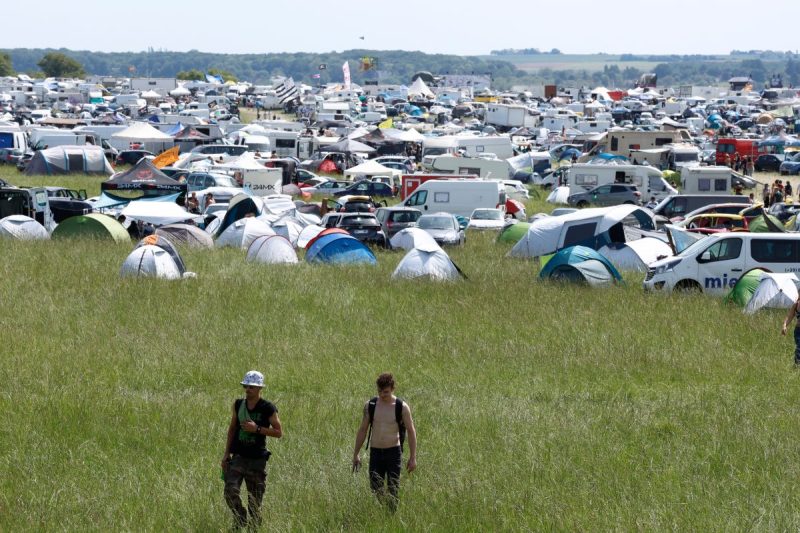
The heatwave has been a disaster for independent music festivals, which were already struggling.
Just last weekend there were half a dozen concert cancellations and festivals that were called off. Some may never return.

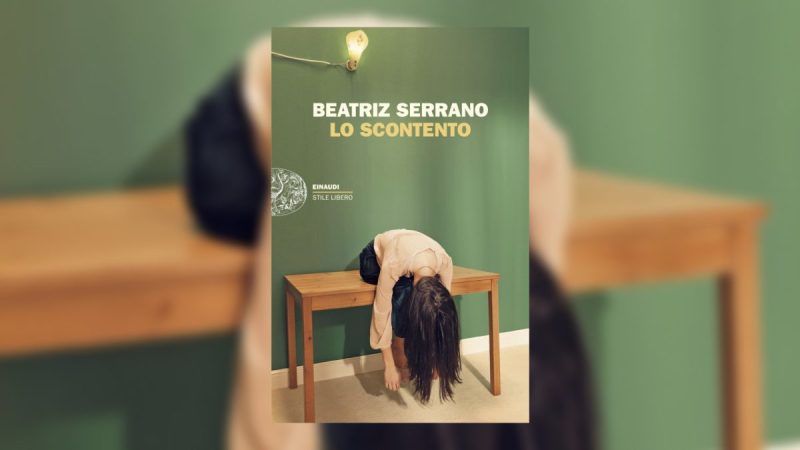
Beatriz Serrano, The Discontent (Einaudi)
Translation by Federica Niola
It was 2013 when the late David Graeber first spoke of Bullshit Jobs, the bible of contemporary creative culture: completely useless jobs with devastating effects on the mental well-being of those who do them. A large portion of “bullshit jobs” coincides with the broad umbrella term “consulting.” Among these are the so-called “Middle managers”: this is exactly the job of Marisa, the protagonist of The Discontent by Beatriz Serrano. It would be difficult to explain to my grandmother what Marisa does: she coordinates a team of creatives and marketing experts in an advertising (or creative) agency in Madrid, she hates her job, and tries to do it for very few hours a day. It is very easy, on the contrary, to identify with Marisa, and that is why The Discontent is an important book to read, to have read, to recite aloud. It is a denunciation, in a sense: of how these “jobs” are the result of a “bullshit economy” from which it is now impossible to find the thread, let alone a meaning other than “this is how it works.” Huge marketing budgets burned in failed campaigns, clients who don’t understand, creatives who take advantage, a life against every principle of happiness. Marisa shows herself to the reader in all her cynicism, her sadness, but also with a humor perfectly managed by Serrano. Reading it, page after page, you would wish her a wheelbarrow of Nembutal, to sink into a well-deserved year of rest and oblivion. Instead, after a corporate retreat of dubious taste, Marisa’s mask will fall, revealing the only possible solution, liberating like the ending of The Waste Land by Eliot: Shantih, shantih, shantih. (Davide Coppo)
 Bruce Holsinger, Guilt (Edizioni E/O)
Translation by Dario Diofebi
There is an easy way to understand when technological development has exceeded the speed limit, and that is to observe how much effort literature makes to keep up. A book comes out that tells a version of our world in which a new technology is causing severe damage, tearing the fabric of society, altering the very composition of being human. This book comes out and is read, and those who read it reach the end and ask: so what? In the time it takes to finish reading the book, technological development has already produced new nightmares, so many and so real and so terrible, that the old ones seem born from the fears of a child who still wets the bed at night. This is exactly the feeling one has at the end of Guilt, a book that glimpses the terrible future that awaits us, beyond the increasingly tenuous boundary separating human whim from algorithmic automatism. There is no world conquered by machines in the future written by Holsinger. Humans are still in power, but the proliferation of AI finally allows the realization of humanity’s ancient dream: to be freed from the consequences of its actions, from condemnation, from morality. Ultimately free from error and morality. AI is useful primarily to the extent that if it makes a mistake, when it makes a mistake, it does so in our place: if one machine orders another machine to bomb a school mistaking it for a military target, whose machine is to blame? Is the penalty scrapping? The junkyard? It should be a terrible book, Guilt. Terrible because predictive, because it tells an inevitable story: humans have invented the machine that will absolve them. And instead, at the end of the reading, one feels only a certain disappointment. Just a quick glance at the phone reveals that Holsinger’s world is wrong, his prediction too optimistic, already unachievable. Technological development has generated a worse world in the time it takes to read a book. (Francesco Gerardi)
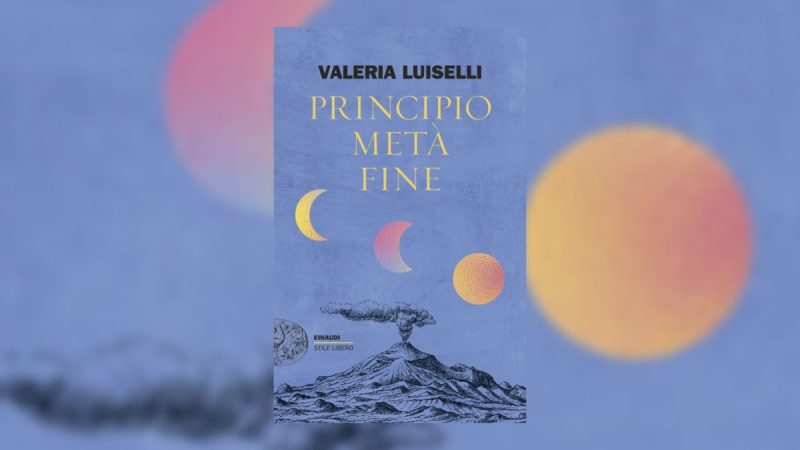
 Valeria Luiselli, Principle Half End (Einaudi)
Translation by Tommaso Pincio
Principle Half End is not only the story, wrapped in ash blown by Etna, of an adventure undertaken by a mother and daughter in search of the past and, at the same time, the possibility of a different future, but it is also a meta-book, which speaks of the complicated gestation of a written work. How does one imagine a story; how should the relationship with writing be lived, whether extractive and utilitarian or as an exercise in patience and waiting; whether we should expect unassailable answers or whether it is perhaps more interesting to offer questions, capable of splitting certainties in two, and allowing us to see, through that crack, a new scenario. The ending remains open, the possibilities are multiple, and the only answers reside in the Mediterranean Sea, where since the time of Greek myths people have navigated, migrating, seeking the hope of an alternative. (Giuliana Matarrese)
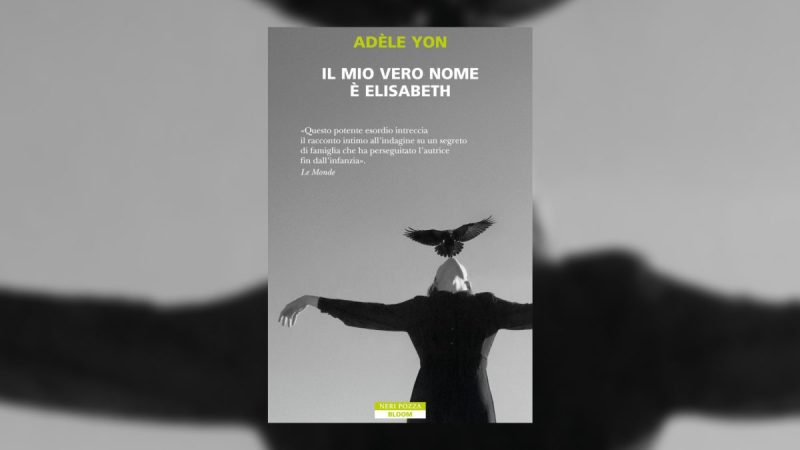
 Adèle Yon, My Real Name is Elisabeth(Neri Pozza)
Translation from French by Sonia Folin
It all begins with a man who takes his own life by jumping from a building in Paris. He leaves a letter in which he confesses to a premeditation lasting fifty years and indicates where to find the keys to a car. In the trunk, there are five books and a photo ID depicting an elderly woman, with a vacant gaze and two round scars on her temples. That woman is Betsy, his mother, and she is the great-grandmother of the writer Adèle Yon, who died before she was born. In the family, a respectable Catholic reality, very little has ever been said about Betsy, and in a dismissive, distant, invalidating manner. From the book: “So, it seems you are researching Betsy? They will never say: about mom, about my grandmother, about my sister. They will always say: about Betsy.” The entire narrative is based precisely on the nebulous figure of Betsy and the search for her true identity. It is an investigation driven by the fragmented memories of the author, who has always been told those few words used to describe her: she was sick, she was lobotomized, she had had six pregnancies, she was distant but always returned in summer, she screamed and was sad. The center of the book is entirely in the account of a granddaughter seeking the truth among the silences and suspicions of relatives. Adèle Yon pieces together the fragments of this puzzle with an immediate and tight style, with an alternating montage structure that recalls her cinematic training. The text runs on two precise tracks, on one side the present of her research made up of recorded interviews and trips to archives, on the other the wartime correspondence of 1940 between Betsy and her husband André and the bureaucratic coldness of psychiatric records from the 1950s. Through clinical files and medical reports, a chilling reality about mental illness and its poor management of the time emerges. The result is a dense, visceral, and at times obsessive work, which is both a family memoir and a feminist manifesto, capable of bringing to light the brutality of male and patriarchal control over the bodies and minds of women. My Real Name is Elisabeth breaks a wall of silence lasting seventy years and finally restores dignity and voice to a woman who had been transformed for too long into an unutterable secret. (Ritamorena Zotti)
 Niccolò Ammaniti, The Guardian (Einaudi)
Many have cried out for the return of a certain old-school Ammaniti, the pulp and irreverent one from the days of Mud, but The Guardian is something more oblique: a literary object stretched between the coming-of-age novel, myth, and the grotesque. Everything unfolds in Triscina, a surreal suburb made of houses thrown haphazardly on a large beach. It is here that the Vasciaveo family moves. And it is here that little Nilo, Agata’s son, receives a bizarre assignment: to watch over “the thing in the bathroom.” The mythological monster, the ancestral fear, is thus confined and reduced to the tiles and drains of a suburban toilet. The magnetism of the book lies in this short circuit: a dialogue between an archaic world – made of ancient Greek and legends – and our suffocating everyday life, where Ammaniti makes his characters move among social networks, television programs, and the debris of contemporary pop culture. A contrast that may be less fierce than expected but still leaves a strange unease behind. (Valentina Ardia)
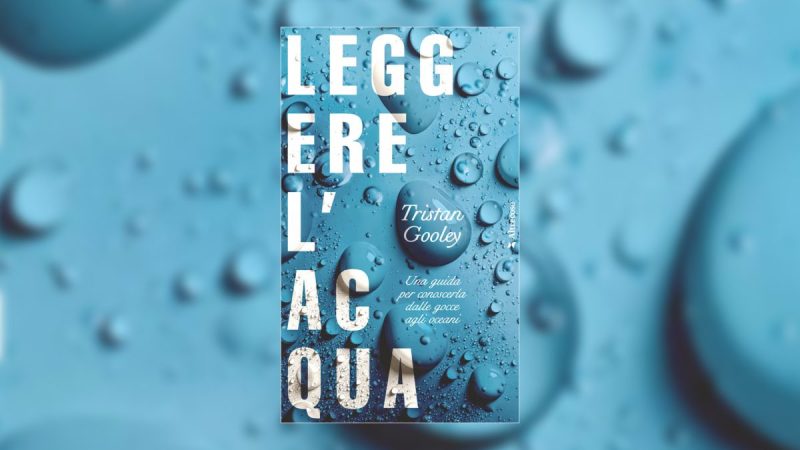
 Tristan Gooley, Reading Water (Altrecose)
Translation by Sara Barbera and Sharon L. Wood
With this heat that prevails, Reading Water by Tristan Gooley is the perfect book to travel into a dimension that restores to the mind that peace and calm that are often lost when temperatures rise, while at the same time posing new questions and offering unexpected answers. The premises are simple: to talk about water and everything, but really everything, that surrounds it, overshadows it, passes through it, makes it flow, filters it, lives in it, and survives it. Gooley is a formidable observer, and in this book, he meticulously addresses all aspects of an element too often taken for granted. From raindrops to puddles (there is a fascinating chapter entirely dedicated to these formations), to the ocean, passing through lakes, aquifers, and the lands that surround them, in this diary of observation, science, and curiosity, he dives into well-known and unknown topics with the same ease with which one listens to fairy tales. What remains at the end of the volume is not only the certainty of having learned interesting and useful notions but the veiled awareness that even behind the most everyday elements lies a world never explored as it should be. It is a feeling that can be frightening; Gooley encourages us to embrace it and understand it as a starting point. (Alberto Biondi)