While the Ministry of Education maintains its commitment to bringing schools back to the times of De Amicis – with the reintroduction of Latin in middle schools and obstacles to sex education – students and teachers find themselves lost in the midst of a second digital revolution: that of AI.
Not even a few years ago, during remote learning, adolescents showcased their best computer skills by hacking online tests that teachers nearing retirement struggled to make copy-proof. No one could have imagined that just a few years later, ChatGPT would arrive. One can only hope that some of those teachers retired in time to spare themselves the whole fuss about the reliability of their students’ work. Of course, the thrill of seeing an unnecessary departmental report, an end-of-year program, hours and hours of streamlined bureaucracy written in seconds will be lost, but it’s still better than finding oneself helpless in front of impeccable text analyses produced by a machine. Betrayed for the umpteenth time by their own students, many teachers today find themselves introducing a new climate of terror in evaluations: “Did you use ChatGPT?”.
I have been teaching in middle school for ten years. Although I work with kids aged ten to fourteen, very few do not own a smartphone. And anyone who has one knows that AI models are presented to us in every possible way, through continuous and aggressive pop-ups. It becomes hard to imagine that a ten-year-old, besides spending the afternoon playing Brawl Stars, won’t eventually succumb to the temptation of using ChatGPT to do their homework. Sometimes it’s the parents themselves who encourage them, just to finish grammar exercises in time for their training.
The Ministry of Education’s guidelines regarding the introduction and encouragement of artificial intelligence in schools are clear: the algorithm cannot replace the teacher in evaluation, nor the students in learning. But it can function as support. For us teachers, however, the less noble task remains to understand where the line lies between what is human and what is not. The days when students casually submitted assignments entirely written by “Chat,” as they now call it informally, are long gone. Today they use it as a personal assistant. If they don’t know where to start, they ask for a couple of suggestions, entrusting it with some unclear exercises. “I did all the work myself, except for that part where I got help from Chat.” Preparing for the middle school exam, one of my students had no qualms about creating an image of the Eiffel Tower – her exam topic will be Paris – overrun by cats.
At first, I used a paid program, NoPlagio – more commonly used in academia – to identify the percentage of text generated by artificial intelligence. It was quite accurate and, in the early days, had the desired effect. The culprits came to light. To my surprise, even some of the best students in the class had to confess, with great distress: they were risking their reputation. But then I decided to work on honesty. Naming the elephant in the room, we started reasoning together. I admitted that I also make use of it. There are countless times when Chat has saved a lesson that I would have had to improvise due to lack of time. In a few seconds, it provides me with a comprehension test, suggests a work outline, or a mentor text for a writing activity. Every time I bring into class material created even partially with artificial intelligence, I declare it openly.
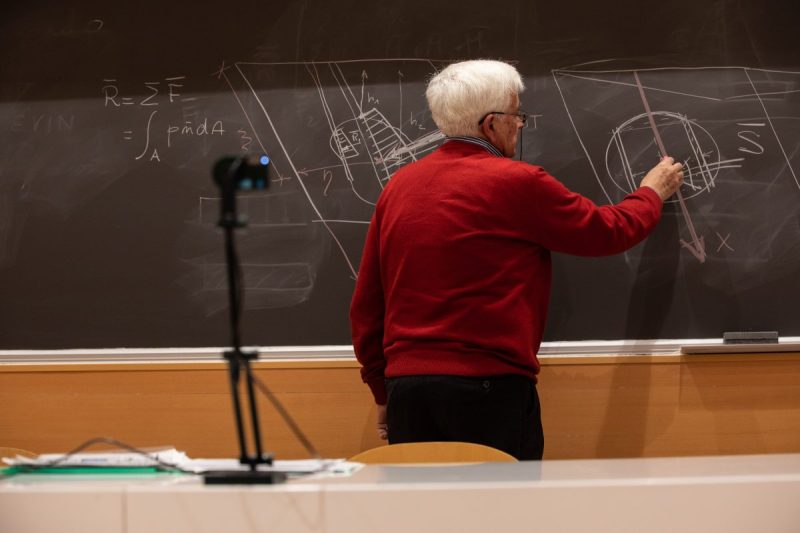
Of course, Chat is not a genie in a lamp. One cannot always rely on it. After the initial enthusiasm, the first disappointments also arrive. I go all in during a grammar lesson. In the general astonishment, I project ChatGPT’s screen onto the smart board. I ask the algorithm to perform the logical analysis of a rather simple sentence, complicated only by the presence of a relative pronoun. And that’s where the machine stumbles. It keeps classifying it as a conjunction instead of as a pronoun functioning as a subject. I insist, “Are you sure?, sure, sure?”, while the class follows the sci-fi skit with amusement. For a few minutes, they trust their teacher more than the machine.
For years, I have forced my students to write by hand, in a special notebook where they can exercise their thinking in an analog way. With decent results, one might say, much to the chagrin of Scandinavian schools that, after years of tablets, e-books, and complete digitization, are rediscovering the value of textbooks and notebooks. In Italy, on the contrary, we have spent most of the Pnrr funds on financing STEM (at least in my school, an enormous immersive whiteboard has been purchased, the use of which I still do not understand, while the idea of a reading room is languishing) but we continue to assign homework as if there were no tomorrow. In this sense, AI should force many teachers to convince themselves that learning occurs in the classroom, not at home. Meanwhile, I already see the next exam prompts, all on Pope Leo’s encyclical Magnifica Humanitas, filled with rhetoric about the return to humanism and the centrality of the person, while another year has just passed, thanks in part to Chat.