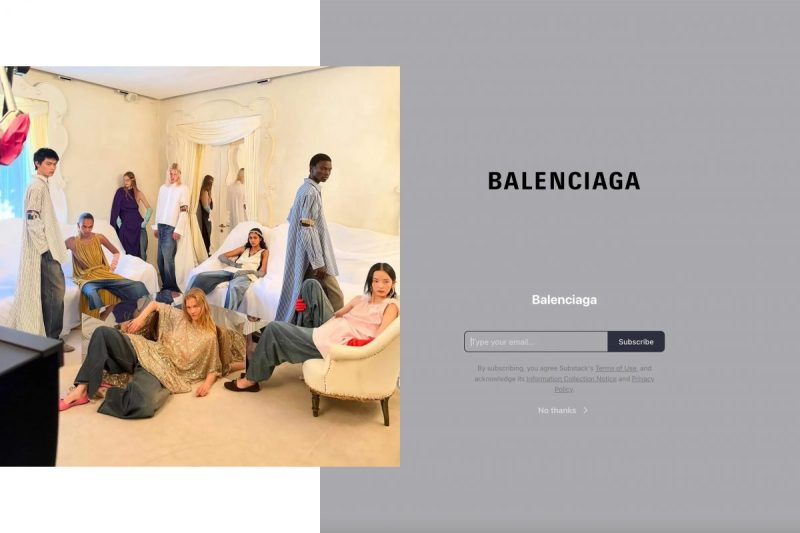
Balenciaga loves Substack so much that it has become the first fashion house to partner with it.
The house has been using the platform for some time: there it announced the arrival of Piccioli and also streams the fashion shows live.

In London, Uniqlo organized a round table to address the elephant in the room: how can a brand with democratic costs reconcile mass production with environmental respect?
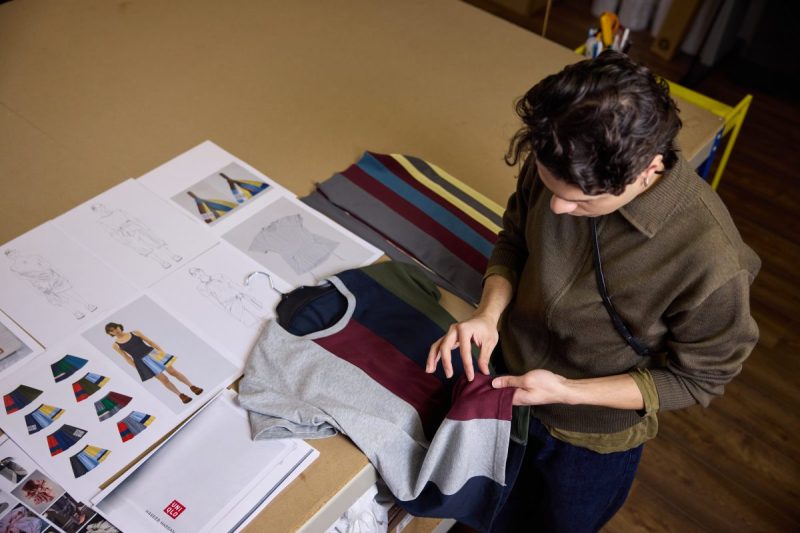
What happens to the clothes we don’t use, those we return because they weren’t the right size, because they had imperfections, or because they don’t fit us as we imagined when looking at them on the site? In the case of Uniqlo, they become a collection that has the potential to become a pioneering experiment, applicable on a much larger scale.
On the other hand, the problem of returns – no longer marketable – is real, and in recent years it has led several brands to provide this service for a fee, to discourage its use. The latest idea from the brand owned by the Japanese group Fast Retailing was to use them to provide two graduates from Saint Martins (Joshua Cronwell and Haseeb Hassan) the opportunity to think of a collection of 10 pieces, called EVERYDAY RE.IMAGINED, available from June 25 at the Re.UNIQLO Studio in 15 selected stores across Europe.
Conceived as a way to give new life to damaged pieces or simply returned by customers after purchase, the collection celebrates inventiveness, the ability to rethink objects born with different functions, adapting them even through visible repairs, patchwork, or overlays, which do not erase the textile memory of the past, but highlight its power and resilience. Japan and its clothing tradition are remembered in the typical Hakama pants of the Land of the Rising Sun, obtained by layering two pants in different colors, while the t-shirts have drawstrings that make them adaptable to changing style or size needs.
The project fits within the broader framework in which Uniqlo operates, which was the subject of a recent roundtable in London, where the brand’s managers discussed with journalists experienced in sustainability like Megan Doyle, a contributor to publications such as Business of Fashion and Harper’s Bazaar. The situation of a brand that is explicitly democratic in costs, targeting a mass market, and has structures operating worldwide can paradoxically become a strength in the virtuous path towards more conscious production and consumption. After all, only those with significant capital to invest in such a path can truly make a difference, experimenting with solutions that have the potential to serve as a template for rewriting the brand’s modus operandi, and perhaps inspire all others, including competitors and customers.
This is explained by the European head of sustainability Maria Ledous, stating that “this project is scalable, and for us represents a format that we can adopt in the future: it pushes us out of our comfort zone thanks to the help of the designers from Saint Martins, to whom we can give a stage to showcase their creativity, but above all it means that we can adapt that design, recreate it, apply it in the different stores we have around the world, and we can do it efficiently. Ultimately, for us, the most important thing is LifeWear, that is, how we can provide our customers with democratically priced clothing, usable in everyday life and that has for them not only economic value but also emotional value.”
Alongside the individual project, in fact, the philosophy of LifeWear unfolds through multiple possibilities aimed, among other things, at recovering clothes to give them a second and deserved life. The Re.UNIQLO Studios where the collection will be present (there are 75 in 23 different markets, one is in the store in Milan in Cordusio) are indeed areas designated since 2022 for the repair of brand pieces: among the most frequent requests is to mend holes in t-shirts or knitwear, reattach buttons and do it visibly, using the traditional Sashiko embroidery technique, which originated in rural Japan in the 16th century by reinforcing and quilting worn garments through the use of decorative geometries. Services that, depending on the extent of the repair, can be free or have minimal costs, and which have been more successful than the brand itself thought possible. The repairs are carried out by the brand’s own employees, who receive specialized training, and who over the years have hosted a series of workshops and events to inform customers of the infinite possibilities a garment has to be lived and relived, or even teach them how to sew using Japanese embroidery techniques (there are different variations of Sashiko depending on the prefectures of origin).
On the other hand, the three words on which the brand insists, putting them in a constant virtuous cycle, are Reduce, Re-use, Recycle. If reduction comes precisely through the use of Re.UNIQLO stores, reuse moves through donations to those in need in areas affected by ecological disasters, or through the Pre-Owned Clothes project that circulates what is “suitable for a second chance.” Finally, recycling divides between what can be recovered and resold and what is instead given to be transformed into insulating material for buildings and machines.
“Fashion has been talking about sustainability for years, it has become an important topic also thanks to social media, but now we need real actions: working on traceability and the supply chain requires significant investments, you have to be truly dedicated, and the business project that Uniqlo is pursuing is very ambitious in this sense,” explained Doyle.
According to the data presented at the London roundtable, in fact, the brand has long-term relationships (between 20 and 29 years of collaboration) with 40 percent of its suppliers, a percentage that stabilizes at 12 percent when talking about active collaborations over a period of more than 30 years, 38 percent of collaborations between 10 and 19 years, and 10 percent that have been in place for less than 10 years. A long-standing mutual trust that has allowed over the years for the reduction of emissions, and obviously greater traceability with careful monitoring. Another interesting point for improving traceability is to intensify the sourcing of raw materials, taking them directly from selected farms and ranches, choosing products that are free of fossil components like coal or oil among others). All actions that have allowed the brand to get on the right track regarding its goals for 2030: reduce emissions by 90 percent compared to 2019 (a goal that has been achieved ahead of schedule this year), increase the percentage of women in managerial positions by 50 percent (currently at 45 percent), and use 100 percent renewable energy in its facilities, both in operational offices and stores (currently at 93 percent). Results that highlight that the path towards a financially solid industry, which operates on a global scale but is aware of the critical issues of the present, is achievable and necessary, even if not easy or instantaneous. And that, by 2026, there are truly no more excuses for not realizing this.