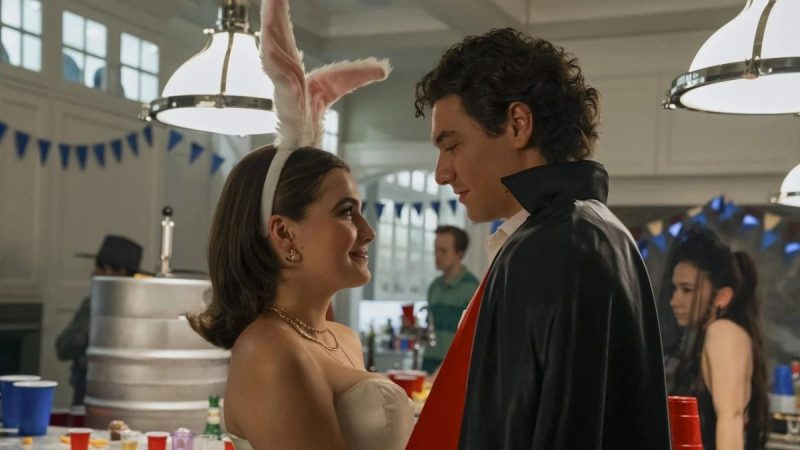
There is a scene in the third episode of the new Prime Video series based on Elle Kennedy’s saga that took over social media just hours after its launch. Hannah, the protagonist, is changing, and Garrett, the captain of the Briar University hockey team (her romantic interest), is in the room. He is turned away from her, and she comments, with a hint of irony, that he will soon see her naked. And he replies: “Yes, but when you tell me.” It’s a scene lasting just a few seconds, yet it speaks volumes about why Off Campus is doing so well, reaching thirty-six million viewers in the first twelve days and, above all, about who is watching it.
The end (on-screen) of the romantic fantasy with the tortured, toxic male
Before understanding what Garrett Graham and the entire Briar University hockey team represent, it’s worth recalling who came before them. For about twenty years, pop narratives aimed at a female audience have centered around a very specific type, codified in recent years through Gen Z slang with a precise name: the “bad boy.” The handsome, problematic, and tortured guy, certainly unpredictable. The one who treats you badly, then well, then terribly, and whose erratic behavior is portrayed as desire, psychological depth, and proof of a special bond that transcends what scares others. The male character strongly influenced the narrative and the role of the female protagonist, who, with her presence, is the only one capable of redeeming someone whom the world has turned into a walking red flag.
Just think of Hardin Scott, the protagonist of the After saga by Anna Todd (published in 2013 on Wattpad as fanfiction and later turned into a film franchise). Violent, verbally aggressive, and manipulative, Hardin repeatedly destroys the protagonist Tessa. But he is tortured, and this, in the narrative logic of those years, was enough to justify everything. The narrative model of After perfectly mirrors the products of EFP, Wattpad, and the Young Adult novels that dominated the first decade of the 2000s and romanticized a not-so-healthy relational model. Readers were not naive; they consumed a fantasy that culture had made the only accessible one. Romanticism was inseparable from risk and destabilization, from the idea that love required female figures to change their partners (constantly doubting themselves and playing the role of caregivers) and male characters to never show their vulnerabilities (hiding them behind a thick layer of anger and absent communication).
The female gaze as a narrative structure
Garrett Graham is not a bad boy. Technically, he has the outward appearance: he is the captain of the hockey team, he is popular, he has the reputation of a womanizer. But he is not aloof, nor does he have a questionable circle of friends: Garrett wants to be better than those who gave him childhood traumas, he does not want anything handed to him because of the important surname he carries, and he is surrounded by friends who are like brothers (TikTok users have called it the Friends of Gen Z). He has a real vulnerability that does not coincide with the champion’s mask and is never used to justify harmful behaviors, but to explain his insecurities. Showrunner Louisa Levy told the New York Times that “there is something very appealing about the idea of taming the bad boy,” but the most interesting thing is that in Off Campus that bad boy does not need to be tamed at all. Firstly, because he behaves in a way that distances him greatly from the “dangerous” archetype: he allows himself one drink the night before an important game, four the night after; drugs and smoking are never mentioned; casual consensual sex without false promises. Secondly, because he does not require female intervention in his process of improvement or growth. Consequently, the female counterpart also takes on a new role: she does not sacrifice herself to serve her partner, but grows and communicates with him, demonstrating a possible synergy between the two roles of the couple.
This does not happen by chance. Levy worked with an intimacy coordinator for all the sex scenes, consulted experts on sexual violence to manage Hannah’s adolescent trauma (present in Kennedy’s books and maintained in the series, but treated without ever showing the event, instead focusing on the daily impact). The care with which the series builds respect in fiction comes from deliberate choices behind the camera, even before they are on the page. And this is exactly the difference between the female gaze as an aesthetic and the female gaze as a narrative structure: not only who watches, but who decides what is worth showing, how, and why.The characters are “green flags” (a term that indicates the opposite of “red flags,” meaning behaviors that the relational awareness culture of the last ten years has taught to recognize as dangerous). Dean Di Laurentis considers consent the key to a successful sexual relationship; John Logan comments “Closed cans are safer” in response to Hannah’s choice not to drink at parties; Garrett Graham acknowledges his anxieties and keeps her grounded in reality. This holy Trinity perfectly meets the demands of the new audience, whose fantasies revolve around sensitive, respectful, sincere figures. And it is no coincidence that it is written by a woman, as in the case of Heated Rivalry, the HBO series of 2025 about queer hockey that became a global phenomenon precisely because it is built around the gaze and desire of a female audience.
Why it appeals to both: the intersection point between Millennials and Gen Z
Gen Z has grown up within the culture of awareness. Terms like “gaslighting” or “love bombing” are part of its genetic makeup; there are no other structures to dismantle. What they seek in stories is confirmation that this vocabulary corresponds to something real, to dynamics that exist in fiction and could therefore exist in life. And above all, that alternatives to toxic relationships exist and are better than any form of romanticization.
Millennials, on the other hand, recognize in this product the aesthetics, the narrative structure, the dynamics of the American college campus that they have consumed for years as fantasies. And indeed, there are many references to early 2000s romcoms: Hannah’s bunny costume inspired by the one worn by Reese Witherspoon in Legally Blonde; grand romantic gestures on the playing field, like in the film 10 Things I Hate About You; lines from The Notebook. Scenes that evoke sweet loves, far from obsession and possession. The most revealing demographic detail is in Amazon’s press release, which defined the series debut as the most watched ever among women aged 18 to 34. Sixteen years of difference that often involve degrees, crises, moves, relationships just begun or ended. Off Campus works exactly in that window because it is not the plot that truly matters, no matter how tender and nostalgic.
Beyond Nate Jacobs
It is important to say it frankly: the plot of Off Campus is annoyingly banal. The fake dating that becomes real, the agreement between two people who can’t stand each other and then fall in love, the secondary characters destined to become protagonists in future seasons. It goes without saying that this is not the engine of the series’ success.
The latter lies instead in the representation of the dynamics. In the fact that when Hannah and Garrett argue, they argue without either of them using the weapon of punitive silence, emotional rejection, or physical violence. In the fact that sexual consent is not treated as an awkward formality, but as a genuine care for the other person. In the fact that both of their vulnerabilities – Hannah’s trauma, Garrett’s family pressure – are shared and welcomed, not used as leverage for power. Seeing secondary characters act as attentive and caring containers generates a certain sense of comfort in the viewer.
Even Nate Jacobs from Euphoria, long the fierce personification of toxic masculinity (misogyny, internalized homophobia, systematic psychological violence against his partners, physical violence towards anyone else, strong personal insecurity), is a crumbled myth: dismantled like the pieces of his battered body, in the third season he becomes a whiny puppet who refuses to accept his failure or take responsibility for his shortcomings. In 2026, this is the new most popular romantic fantasy, because two generations have processed (even in therapy, now increasingly destigmatized) enough to know how to desire something different. Garrett Graham’s gesture of turning around while Hannah is changing is not heroic; it is the bare minimum. Today’s generations are well aware of this.