In Eleonora Marangoni’s latest book, The Unmissable, the author searches for the forgotten inventor Walter Hunt. To dig into his life, she goes to his hometown in the countryside of New York State. When she arrives, not only do they know nothing about him, but they practically label him a loser because, despite having talent, he never managed to monetize his inventions (the most famous: the safety pin).
In fact, someone even suggests to Marangoni to forget about the book and instead write something – “maybe in English!” – about another guy who actually managed to make a fortune. In America, those who make money, more than those who create useful or beautiful things but die in a small apartment, reach a level of epic heroism. It’s a layered idea, so deep in the Anglo-Saxon soul and especially of the frontier, that it is hardly uprootable. Also because it can bizarrely coexist with that same Dickensian (or Disney-esque – see Family man with Nicholas Cage) ethic that acts as a false backlash, like a moral barrier of smoke. After all, Scrooge is not so much criticized for making money, but because he thinks only of it and does not give back to society.
His narrative arc concludes when he realizes that love and affection and helping others are more important than mere profit. But capitalism itself in A Christmas Carol is not called into question. In fact, the ghosts remind Scrooge that in the end systemic poverty can jeopardize the entire society, and thus in the long term even his own business activities. Let’s not invoke Kant, but in the end giving holidays to his employees and bringing panettone to the Christmas dinner ultimately benefits Scrooge, besides making him feel better. However, let’s invoke Max Weber and a phrase from his 1904 bestseller: “Man is dominated by making money, by accumulation, as the ultimate goal of his life. The acquisition of money is no longer linked to the material needs of man as a means to satisfy them.”
The final boss of capitalism
Elon Musk has become the richest man in the world and according to many historians, there has never been anyone during the adventure of homo sapiens on earth who has managed to accumulate so much material wealth. In him, the true maximum spirit of capitalism has triumphed. He is the exemplary spy of this phase that experts call “late stage,” where there is an extreme concentration of resources in the hands of very few and where money is not so much used to buy as to be. To quote Nolan’s Joker who sets fire to the mountain of bills: “It’s not about money, the point is to send a message.” Unlike other tech oligarchs, Musk does not own a yacht, he doesn’t even find pleasure in playing Monopoly with mansions – he has long lived in prefab houses similar to containers – and once his ex Grimes said he lived “below the poverty line” to the point that he asked her to bring his mattress home because his had a hole. They almost only ate peanut butter, she says. So the point is not to exchange money for goods and services, but to reach the highest level. And if we trust what his former collaborators say, the ketamine-fueled Elon Musk believes he lives in a simulation. The world and life are a video game in which he is the protagonist. And he has just reached a new gigantic level in this video game. Or he has won, but can continue to play.
“For now, I’m doing some side quests,” he said a year and a half ago when he was still in the Oval Office, Bff of Donald Trump, “Gothic dark Maga,” and sleeping on the couch at Mar-a-Lago. Other quests include reaching the “multiplanetarity” of man, which he seems to have partly given up on recently, aiming for the Moon instead of Mars. Another quest – or perhaps it’s just dementia and compensation from an ex-nerd without friends – seems to enjoy pushing extreme right xenophobic parties on X (which he owns and where he allows the use of the n-word and all other offensive words found in all dictionaries of all languages).
And now? Someone might ask after reaching this symbolic number of a trillion, a bit like George Clooney in Up in the Air when he surpasses a million air miles. The fact that newspapers have to use infographics to explain “how much is a trillion” explains everything, complete with stacked coins to reach the moon. If a million seconds are 11 days, a billion seconds are 32 years, a trillion seconds are 32,000 years. Someone points out that if you only have 1 dollar you are closer to Jeff Bezos’s fortune than Bezos is to Musk. American progressives have started calculating what could be done for the State with those figures, like building two million homes for the homeless, providing free meals to every child for decades, or making all U.S. universities free for almost 15 years. Democratic Senator Warren reminded that the average American family would have to work 11 million years to reach Musk’s fortune.
These are titanic proportions, which, like when looking at the sizes of stars, are difficult for the human mind to comprehend. Just as many humans do not understand that they should not be afraid when they say “tax the rich,” because they will never be touched by the axe, even if capitalism, to survive, leads you to think – a very American mantra – that you too, yes you, could one day be as rich as Musk. “Reason number 1,000,000,000,000 why we should tax the rich,” wrote Mayor Mamdani. On X, it has unleashed a storm. “If in nature a monkey were to gather a trillion bananas, the other monkeys would beat her to death and take her bananas.” Someone else wrote: “I wonder when the moment will come for the first trillionaire to die in history.” Bringing up the psychological issue, someone posted: “No one is envious of the first trillionaire because no one is jealous of someone who spends all day sitting in front of Twitter retweeting racist stuff. The brokest guy I know spends his days in exactly the same way.”
Public investments, private trillions
Once Musk asked the United Nations to prove that six billion dollars would solve world hunger, which affects 42 million people. The UN got to work, proved it, and Musk ghosted them. And we’re talking about an amount less than 1 percent of his wealth. When he was in charge of Doge – another side quest – Musk spent months committed to cutting U.S. state expenses with a chainsaw (among other things, to the anger of the sovereignists, since that is not even his native homeland). Musk has proudly contributed to destroying the welfare state, and for this reason, it should be remembered that the symbolic money he has accumulated exists because there are state contracts from his SpaceX, especially in the initial development phase.
The first major push for SpaceX came from NASA in 2006 with 278 million dollars, to develop the Falcon while the Space Shuttle program was being shut down. Two years later, Musk himself admitted that in 2008 he was practically out of money if it weren’t for a state contract worth 1.6 billion. “I couldn’t have started SpaceX, and I wouldn’t have reached this level, without NASA’s help,” that is, a public agency funded by taxpayers. He said this in 2012 when he was still selling himself as a progressive and before the fascio-nerd regurgitations or the late impulses of those who grew up comfortably in African apartheid had emerged. That’s why Musk (like Bezos or Zuckerberg or the Tolkien gang of Palantir) cannot really be boycotted; to do so, one would have to boycott the State. “No one embodies the machine man of the 21st century better than Elon Musk,” write Slobodian and Tarnoff in the book Muskism (just released by Einaudi), comparing him to a Hobbesian Leviathan built with pieces of Tesla. To use, exploit the State (and public money) to replace it with oneself, becoming a drugged cyborg version of the titans that preceded the peace brought by Zeus.
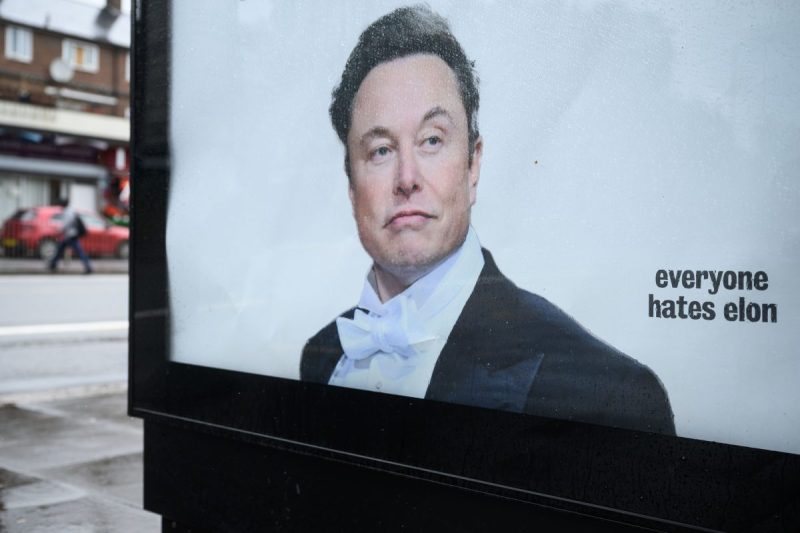
But what do we make of this news about Musk the trillionaire? Should we try to find the good in everything that happens or accept the necessary anger to react, without falling into Franciscan moralism? Perhaps the good of the new level reached in the pathetic video game of Musk’s life is that it sends a signal, becoming, like the historical falsehood of Marie Antoinette’s brioche, a symbol to rally against, the spark of something organized. Perhaps it is yet another sign that the theories of the philosophers published by Verso books are correct. Perhaps it is a way to recalibrate values: especially after the Knicks’ victory, the Muslim Mamdani in New York is like God, while for Musk, groups like “Everyone Hates Elon” have even been born – being presumed tech wunderkids, pale and hairless, playing Doom and dropping acid is no longer cool, make way for socialists who eat bagels, play soccer, and marry pro-Palestinian artists from Damascus. Perhaps Gen Z will save us, not those who go to interview millionaires for advice on how to get rich, but those who say no to underpaid or boring jobs just to do what they love, even if it means doing nothing, and throw away their iPhones to replace them with dumbphones. Or perhaps this trillion-dollar thing is a way to remind us that money, like the Nasdaq and bitcoin, ultimately doesn’t really exist.