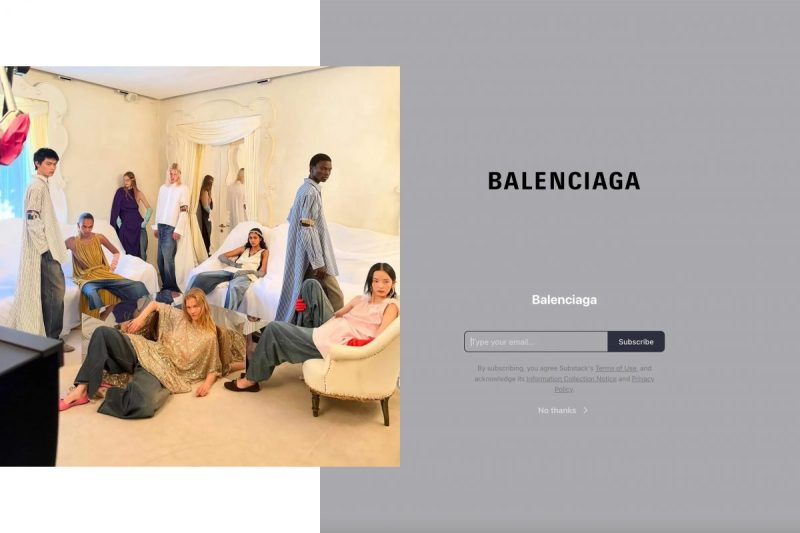
Balenciaga loves Substack so much that it has become the first fashion house to partner with it.
The house has been using the platform for some time: there it announced the arrival of Piccioli and also streams the fashion shows live.

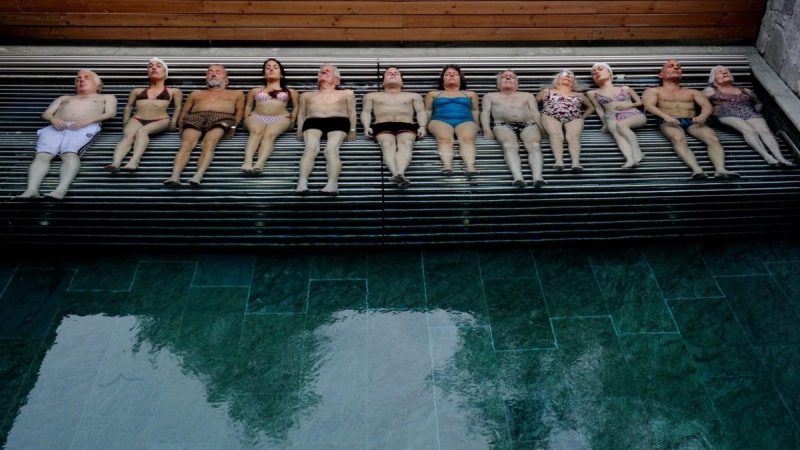
In the face of price list crises and consumer disaffection, fashion stops dressing the body and begins to court immortality. Well-being is the only accessory capable of justifying a dizzying price list with the promise of a better (and longer) life.
This article is taken from the new issue of Magazine Studio, titled Living in the permacrisis. You can find it in our online store.
When Cosimo Rondò decided to climb a tree and then never come down, living his life hopping between oaks and carobs, according to Italo Calvino, who narrated his fantastic adventures in The Baron in the Trees, he was not making a misanthropic choice to distance himself from humanity (and indeed throughout the story Cosimo comes into contact with pirates, tries to foment revolutions, falls in love, and befriends bandits) but rather reaffirming a peculiar identity, while still being part of a social context. And indeed, Calvino has him say: «He understood this: that associations make a man stronger and highlight the best qualities of individuals, and provide the joy that one rarely has when remaining alone». A sense of community that, although lacking the arboreal ascents of the young baron, many are experiencing today.
It may be the complex geopolitical situation, or the increasing disaffection towards social networks often deviated from their original goals (connecting distant people) and more instead subservient to obscure technocratic projects, but the idea of making room, in one’s economic planning, for moments spent with others, sharing passions, ideals, and goals, seems to have become of primary importance. How can this conclusion be drawn? Simply, from the economic strategies of the major conglomerates in the luxury world, which in recent years – also due to their ever-increasing prices, a move that is proving to be a spectacular harakiri – have found themselves removed from the wish lists, withhandbags and shoes with price tags that are hard to justify with claims of craftsmanship, in favor of yoga class subscriptions, dietary supplements, spa stays, and private club memberships. This has also been confirmed by the study from Altagamma and BCG (Boston Consulting Group), which defines the rise of the “health as wealth” paradigm, asserting that the new luxury is well-being.
«The categories associated with personal enrichment and lasting value over time — such as well-being, beauty, and interior design — are those that are growing the fastest, with double-digit growth forecasts» reads the report. «This reflects the spread among high-end clients of a clear “health-as-wealth” mindset, which considers well-being, aesthetics, and the care of personal spaces as fundamental dimensions of luxury, with an estimated increase in spending of around 10% over the next 18 months».
An approach that risks, for those with enough money and free time, becoming not just a lifestyle but a mission: take the case of Bryan Johnson, a 48-year-old terrified of aging, who calls himself a “biohacker,” essentially someone who plays cards with biological decline, with the ultimate goal of defeating corporeal transience and becoming immortal (he claims that the result will be achieved, according to his calculations, in 2039). To do this, Johnson – who recently walked the Parisian runways for the brand Matières Fécales – follows elaborate longevity protocols: a minimum of 6 hours of training per week, sleep measurement, obsessive attention to diet, with supplements and skincare, costing 2 million dollars a year. Protocols that from this year will be available to three lucky participants in the Immortals program, for the price of 1 million dollars. Regardless of the exaggerations with superhuman aspirations borrowed (poorly) from Nietzsche’s philosophy – which Peter Thiel, another shadowy tech-bro godfather of Elon Musk and supporter of the need to “transcend democracy,” often cites (we already discussed this on Studio back in 2017 and talked about it again recently) – the general public, with varied spending capabilities, seems more than ever interested not so much in the single product, but in the values that underlie belonging to that universe of references.
«Today, customers are much more informed and much more selective. They do not stop at aesthetics: they look at the real quality of the product, the credibility of the brand, and the consistency between what a company says and what it does» confirms Benedetta Petruzzo, International CEO of the Los Angeles brand Alo. «There is also a strong interest in brands that speak of well-being, balance, and a lifestyle that makes sense in the long term. I believe that in general there is a search for authenticity and for experiences that are personal. It is no longer so much about buying a product but about being part of a community of people who share a viewpoint, a value system, but also a way of living. In this sense, people are looking for brands they feel close to, not just to wear, but with which to identify themselves». The fact that Petruzzo, before taking on this position (she was officially appointed on January 12, ed.), was at the helm of brands like Miu Miu, where she was CEO, and Dior, where she was managing director, speaks volumes about how the wind is changing and the new air has been felt even in the gilded palaces of Parisian maisons.
In November, for example, Kering’s CEO, Luca de Meo, announced the start of a collaboration with L’Oréal to jointly prepare projects dedicated to longevity; meanwhile, last year Dior opened its first spa in Italy, within Lo Splendido, a hotel in Portofino, and in May launched its own line called Haute Wellness, (pilates mat, water bottle, and weighted wristbands). Armani, which already has hotels with related spas, bars, and restaurants, acquired the historic Capannina di Forte dei Marmi last year, to revive the universe of meanings in the brand also in the nightlife world, and moreover, has decided to continue investing in the hospitality sector, signing an agreement with Symphony Global of Mohamed Alabbar, to continue developing not only (other) luxury hotels but also third places, designed for a younger high-end clientele, seemingly attracted not so much by the brand, but by the aspiration towards a certain type of “lifestyle,” a term now ecumenical in managerial circles, which seems destined for the sad fate of overuse that befell “heritage” in previous years.
«The theme of longevity is a macro trend that we observe across diverse geographies, age groups, and income levels» explains Filippo Bianchi, Managing Director and Senior Partner at BCG, where he heads the luxury division. «A change that has also been made possible by technological progress, and consequently by apps and services, which can now manage countless parameters to define what well-being means. Consequently, the theme is no longer certainly niche, but mainstream. In the world of high-end consumers, we have moved from “trust me, you will dress better” to “trust me, you will live better”: ultimately, the focus on well-being does not change the definition of luxury, but it can certainly expand it».
An approach that seems to work more in smaller brands, with a precise inclination: Alo, of which Petruzzo is CEO, was born as a brand dedicated to the clothing needs of yoga practitioners, and today provides not only clothing but also leather gym bags costing three thousand euros, an app for home workouts, a real Los Angeles club for classes, as well as countless meeting opportunities in various cities across the United States with industry experts and, finally, retreats in exotic locations. A brand that is its direct competitor, Lululemon, has long organized events of various sizes – from in-store meetings to collective yoga classes in the park – with no economic barriers to entry: almost all of these events are indeed free. Rapha, which specializes in clothing and accessories for cyclists, has several Cycling Clubs in North America, Asia, and Europe (none yet in Italy): the first was opened in London in 2012, and by signing up, members can access weekly events organized with a coach, meet other enthusiasts at the bar for coffee, receive discounts on sports insurance, and have priority on new product launches.
More than objects, this is about closeness to a brand that seems to speak to us, with us, about us: a type of relationship that today seems to reflect the definition of “luxury.” «We start from a very simple conviction: today true luxury is feeling good» continues Petruzzo. «Feeling good in your body, having time and space to take care of yourself, living in balance. We believe that the values that inspire Alo – well-being, awareness, balance – can elevate very simple gestures of the day and help people live better. In this sense, Alo has built over time a very specific space, at the intersection of well-being and luxury. Not a traditional or ostentatious luxury, but a luxury linked to quality of life, care for the body, and a community of people who share the same values». How the maisons, by their inclination towards a certain selection at the entrance, will translate and monetize this desire for “connection” remains an unknown. «It’s a big question» confirms Bianchi. «If in the lower part of the pyramid creating belonging is possible even through the recognizability of products (for example, the logo), through which customers identify themselves, in the upper part, the consumption of luxury goods has always been conceived as an introspective experience of the individual rather than of a group. The theme today is to ensure the right degree of selectivity: this could happen, for example, with private clubs, which are experiencing growth, and could represent an easy extension of the brands’ universe».
While the maisons are trying to solve this question, some initial signs of openness are emerging: some of them are starting to increase the variety of products available at entry price points. On Dior’s website today, you can find ballet flats that cost less than a thousand euros, as well as some heels from Gucci’s latest runway sold on the brand’s site for 950 euros. Who knows if this will be enough to rekindle consumer interest or if, after being closed for a long time in their gilded palaces without speaking to anyone, unlike Cosimo Rondò, the fashion maisons have definitively lost the ability to engage with the real world.