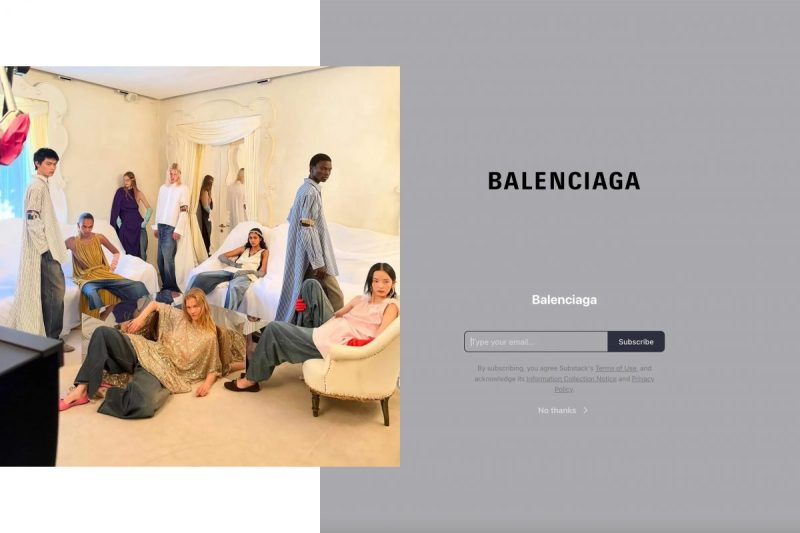
Balenciaga loves Substack so much that it has become the first fashion house to partner with it.
The house has been using the platform for some time: there it announced the arrival of Piccioli and also streams the fashion shows live.

Gucci's partnership with F1 has surprised many, although it was predictable, because in fashion, clothes are no longer enough, and Demna perhaps understood this before others.
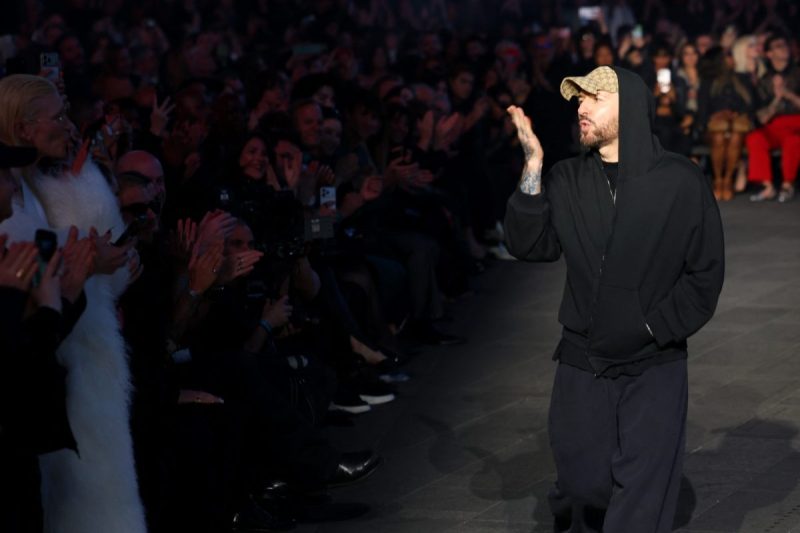
The video that Gucci aired on the screens of Times Square before the Cruise show ten days ago is uploaded on YouTube, and to date it has 11 thousand views. In contrast, the one from the subsequent show, predictably, has 5.1 million. And it’s a shame: not because that 8-minute video, which combines a series of fake advertisements for fake Gucci products, is particularly beautiful, but because watching it would have made clear, almost obvious, the idea of Gucci Racing, which yesterday raised several eyebrows among the online community.
The entry into F1 as “title partner” of the Alpine team, which starting from the 2027 season will race under the name “Gucci Racing Alpine Formula One Team,” was indeed anticipated by that video: among the various ads, which appeared more bizarre than the last – Gucci water “Alpine water” conceived “from Tuscan Hills” with images of a glacier, Gucci Viaggio with sleep masks floating inside a spaceship with the tagline “the sky is not the limit” – there was also one for Gucci Racing, except that the fake project was called “Gucci Automobili.”
And while commentators were squabbling over the “GucciCore” show, igniting the usual pro and con fandom regarding Demna, Demna was already thinking of a world where clothes are no longer at the center of the discourse, but brands remain relevant. An approach that has been fully embraced by uber CEO Luca de Meo, also because in recent years, the most important strategies of brands have not played out on the runways, with (beautiful/ugly) clothes but in boardrooms where, among consultants and managers, it has been agreed that if fashion wants to survive this moment of crisis – in which, apart from virtuous exceptions, most brands find themselves – it must simply take everything, occupy every position on the field, brand any identity object, reach screens and wish lists even of those who have absolutely no idea who Demna is.
This is an approach that has already been experimented with to a lesser extent in the ’80s, when many brands, unable to sell more clothes than they already were, before preparing the winning formula of the “it bag” with its high profit margins against minimal production costs, began to produce licenses for products of any kind. There were the tiles of Gianfranco Ferré – which are still found in the seaside homes of grandparents or in the bathrooms of restaurants with 40 years of honorable service behind them – the 600 licenses of Pierre Cardin, from wines to toilet paper, even Valentino Garavani’s car, a chrome red Alfasud, not to mention those that today we consider inherent extensions of the brands themselves, as part of the broader group of accessories: watches, glasses, and more recently makeup.However, in 2026, the large conglomerates that oversee the brands are not satisfied with just putting their logo on individual products: the desire is to colonize other contiguous imaginaries (and with high growth rates, unlike the clothing industry) expanding their area of influence like wildfire.
Investments are made in third-party places, which can be containers of potential customers, perhaps in partnership with institutions in the food world, a maxi group that includes Louis Vuitton’s Da Vittorio Caffè and the historic pastry shop Marchesi purchased by Prada in 2015, as well as the Principe café in Forte dei Marmi, also by Prada; there is also a focus on hospitality, with Giorgio Armani already owning several hotels named after him around the world, who at the beginning of the year decided to increase investments in the sector; football teams and globally popular tennis players are sponsored (Gucci and Sinner, Musetti and Bottega Veneta, Liverpool with Tommy Hilfiger, Louis Vuitton and Real Madrid, Brioni and Como) but also F1 teams, a market whose fans are growing exponentially, thanks especially to the Chinese market; branded spas are opened, because in critical times like these, our first thought, according to market research, is related to our health and mental well-being (we discussed this in the Industry newsletter, and also in the new issue of Rivista Studio); there is an attempt to colonize the nightlife imaginary, with Armani having acquired La Capannina in Forte dei Marmi in 2025; they enter customers’ homes with interior design lines and dishes (those in the Gucci video with a clamp, appearing in a phantom Venetian Palazzo Gucci while Tony Renis sings Why why are fake, also because Kering in its extensive portfolio already owns Ginori 1735).
Where sectors are instead afflicted by the same economic crisis as fashion, they are still monitored, because the cultural authority that derives from it is the greatest profit: thus, production houses are created to support films that feel closest to their sensibilities, where obviously actors and actresses will wear the brand’s clothes (Saint Laurent Productions was the first luxury house to embark on this venture, supporting among others Sorrentino’s Parthenope, but also Mother Father Sister Brother by Jarmusch and Emilia Perez by Audiard); notable writers and cultural operators are invited to literary clubs (Miu Miu). And then, even as in that fake Gucci ad, the limit imposed by the sky is surpassed to go into space (Prada creating the space suits together with Axiom).
In this sense, that show – hated, criticized, talked about, brilliant for some, a fatal blow to elegance for others – was much less revealing of the brand’s strategies than the video that preceded it. Because that setting – in Times Square, at the center of capitalism and a U.S. market that is the one to court now for big brands – and those clothes – a mephistophelic variation from the Gucci gospel according to Tom Ford, with pinstriped business suits and sharp evening gowns with feathers and fringes – are certainly the most visible emanation of the brand’s storytelling power, but today the maisons can no longer be just containers of meaning that passes exclusively through clothes, but must be capable of containing universes of meanings, spendable and quickly associable with different merchandise sectors. Because, since the ’80s, everything has changed, and those respectable Parisian, Florentine, and Milanese palaces where strictly family management preserved with blatant elitism the secret of elegance, have become global mega-brands listed on the stock exchange, and therefore driven by the necessities of finance, which imposes constant growth, or death. And if clothes are no longer enough – or are not in fashion in this precise historical moment, driven by other passions, needs, impulses – the only alternative is to take everything else.