Due to the growth of the wellness industry, incense is becoming an increasingly rare and expensive commodity.
The demand is too high and the trees that produce incense resin are not enough. At this rate, in 20 years, global production will be halved.
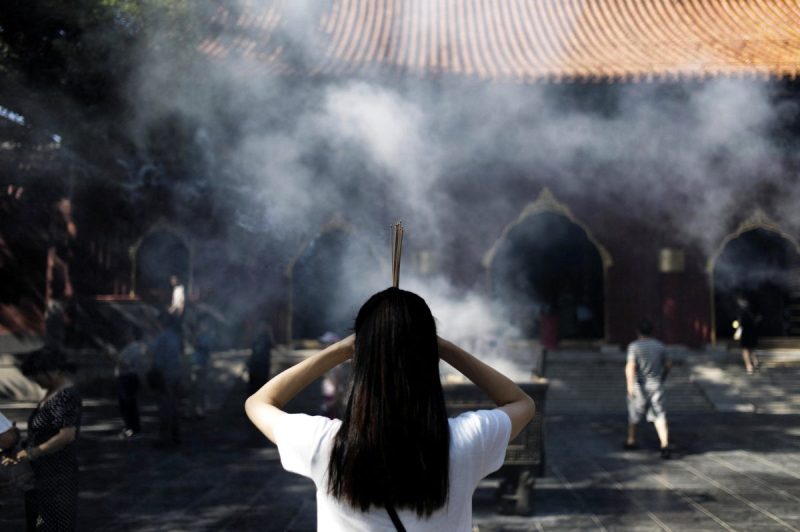
In recent years, the growth of the wellness industry (whose value is estimated today at around 5.5 trillion dollars) has corresponded to an increase in the demand for incense, used by many people around the world as an “olfactory background” for meditation and yoga. As often happens when the market begins to demand a good with increasing insistence and in greater quantities, the result of this incense boom is an environmental crisis. As Lauren Hadeed writes on Bbc, already in 2019 a study published in Nature explained that 75 percent of Boswellia tree populations – the main source of resin for incense, primarily found in Ethiopia, Somalia, and Sudan – lacked young trees and that the natural regenerative process of adult trees had been “stopped for decades” due to the invasiveness of grazing animals, the frequency of fires, and excessive resin extraction. According to this research, without initiatives to protect the Boswellia tree, incense production will be halved in twenty years.
However, the problem is not only environmental. The incense industry is extremely profitable in the West but poorly regulated in the Horn of Africa countries that constitute the first link in this production chain: there are no certain rules to protect Boswellia trees from excessive exploitation nor the workers who collect the resin, often mistreated and underpaid. In several cases, these people are forced to endure grueling shifts and are paid based on the amount of resin they manage to collect in a day. Even if they manage to collect a huge amount of resin, the worker will still earn very little: if the resin is sold in the West at a price ranging from a minimum of 60 to a maximum of 100 dollars per kilo, the person who collected it earns at best five dollars per kilo, at worst barely two.
The fundamental problem is that Boswellia trees are not made to produce so much resin. The traditional extraction process involves a small incision on the tree’s bark, from which the resin flows and then solidifies into small crystals called tears. Before the demand for incense exploded, resin collectors knew they could not ask too much of the trees and understood that exploiting them would cause serious and sometimes irreparable damage: according to a 2022 study, a Boswellia tree takes ten years, and sometimes even longer, to heal from the damage caused by exploitation. All this clashes badly with the fact that the most recent projections say that the incense market will double its value by 2032, rising from 363 million dollars to over 700.