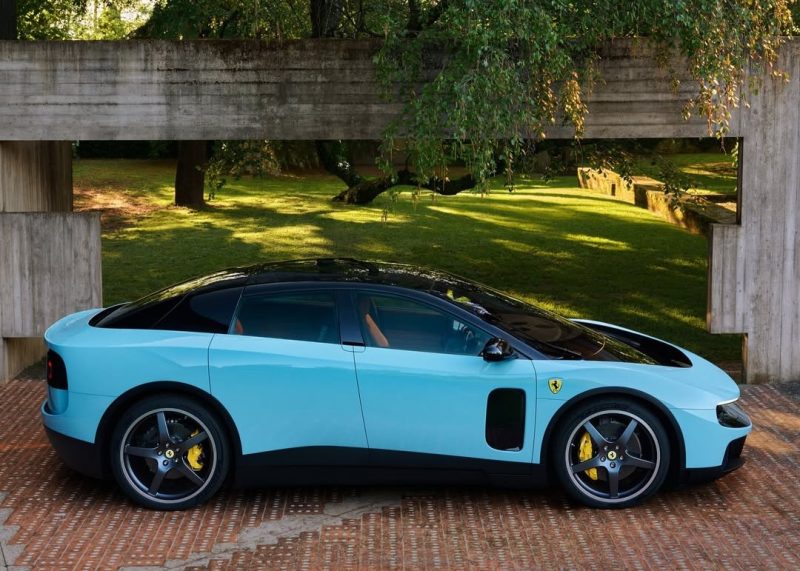
The Ferrari Luce was supposed to open the future of the Prancing Horse: for now, it has opened a rejection crisis. The first electric Ferrari was not received as a new model, but partly as an aesthetic blasphemy, partly as a foreign body within one of the most powerful industrial imaginaries of the twentieth century.
The point was the scale of the negative reaction: a global shitstorm involving offended Ferrari fans, nostalgic for the V12, nervous investors, detractors of electric cars, and social media users who will never buy a Ferrari but still feel compelled to say what a Ferrari should be. These reactions, more than about the car, say a lot about the brand: Ferrari is not just a car manufacturer; it is a piece of collective imagination, something untouchable like and more than a mother. Ferrari is made of an impalpable material that contains Italy, speed, wealth, childhood, Formula 1, red, noise, victories, and defeats. It is a private company, of course, but it functions as a public emotional asset.
For this reason, every new Ferrari is judged twice: as a product and as a potential betrayal. The Luce has been judged primarily in the second way.
Ferrari wanted to shock
Adam Hay-Nicholls, an English journalist specializing in automotive, believes that Ferrari knew very well it was taking a big risk. “I think they anticipated this, and that’s also why the launch was under such a heavy embargo,” he says. “Journalists had to sign contracts committing not to release photos, videos, or even just information about the launch, like the location of the event, with liability for damages up to 500,000 euros.” According to Hay-Nicholls, Ferrari was not looking for a smooth transition; it was looking for a shock. “Ferrari wanted to shock. They turned to LoveFrom because they wanted a complete break: a completely new idea of how a Ferrari should look if the last 79 years of automotive history had not existed.” So not just a new engine, but a new idea of Ferrari: electric, five-seater, closer to a technological luxury object than to the sports car on which the myth was built. Hay-Nicholls does not believe that the Luce can really harm Ferrari economically; the brand is too strong and too desired: “The Luce will meet its sales targets and make a lot of money,” he says, “and the stock price will recover quickly.” Then he adds a less reassuring sentence: “I wonder if in twenty years the Luce will be considered an oddity“, a peculiarity, a side episode in the history of the Prancing Horse.
The new Ferrari customer
The Luce is not just the first electric Ferrari; it is the first Ferrari designed for a customer who may have no sentimental ties to the Ferrari of yesterday. It is not said that they grew up with the F40, Testarossa, Schumacher, or the sound of the twelve-cylinder engine. They could be a billionaire born in the nineties, a tech entrepreneur, an AI sector founder, a global buyer little interested in Ferrari tradition but very interested in the latest industrial object bearing the Ferrari brand. Someone who cares about the new, in every possible sense. Hay-Nicholls identifies this target quite clearly. “Ferrari wants to attract wealthy customers and retain them so they come back to buy again,” he says, “it doesn’t want to sell one car to each customer; it wants to sell them twenty.” According to him, the owner of a single Ferrari, perhaps a 296, is unlikely to buy a Luce. “The person who already owns twenty Ferraris, however, might do so.” The ideal customer is new, international, and probably not too attached to the orthodoxy of the Prancing Horse. “The target is people who have already chosen electric, who love technology – and who perhaps made their money in technology – and want a practical, fast car with status. California and China are obvious territories, and then there are women. The Luce will bring many women to drive a Ferrari.”
The impossible fans
Yan-Alexandre Damasiewicz, a French journalist and one of the sharpest observers of the Ferrari world, is more blunt. Ferrari could expect criticism, he says, but perhaps not a reaction of this violence. “The Ferrari fan is deeply traditionalist,” he says, “they cannot stand Flavio Manzoni, they cannot stand hybridization, and this car is simply too far from everything that has been done before. For many Ferrari fans, it is simply impossible to understand.”
Even in his reading, the Luce may have been conceived outside the perimeter of the classic Ferrari fan: not for traditional customers, but for other customers. The problem is that, in doing so, Ferrari has touched the raw nerve of its own myth. “Perhaps Ferrari’s strategy, John Elkann’s, was to say: this car is not for our customers; it is for other customers. So let’s make a car that has nothing to do with Ferrari’s history.” But is it possible to evolve Ferrari without provoking rejection? For Damasiewicz, no. Every transformation of a brand so loaded with expectations produces resistance. Today, however, this resistance is more radical. “We live in a world that seeks refuge in conservative values,” he says, “we want to live in the past more than ever.”
The examples he cites are clear. The black front fascia introduced by Manzoni on the 12Cilindri was hated, ridiculed, turned into memes. Yet the Daytona, in the seventies, already broke with round headlights through its plexiglass front. The 288 GTO mounted a turbo V8, technology derived from Formula 1, without being seen as a violation of majesty. Today the F80 is attacked for not having a V12, even though it carries within it technologies related to contemporary endurance. “Ferrari has realized it has impossible fans,” says Damasiewicz. A fandom that lives in a paradox: Ferrari has always been innovation, but its audience accepts the future only when it resembles the past. And not always even then.
It is not purism
But dismissing everything as traditionalism would be too easy. Here, the intervention of Fabio Filippini, former vice president of Pininfarina and car designer who has also collaborated with Ferrari, shifts the discussion to a different terrain. For him, the problem is not that the Luce breaks with Ferrari tradition. The problem is that it does so poorly. “It’s not a matter of traditionalism or purism,” says Filippini. “The design of a Ferrari does not always have to follow the same formal trends. Even the Daytona or the BB or the Enzo, not to mention the Modulo, were a radical break from previous forms in their time, but they did not abandon the spirit of the brand; rather, they took it into new territories.”
A Ferrari can be revolutionary; perhaps it must be: but it must remain a Ferrari, and according to Filippini, the Luce fails precisely here: “Regardless of the fact that the car, in my opinion, is embarrassing from a purely aesthetic point of view, I simply believe that the problem highlighted by everyone is the detachment and the evident denial of all those deep, consolidated identity values that make the uniqueness of the Ferrari brand.” For Filippini, the Luce does not truly innovate on a stylistic and formal level and takes existing codes of automotive design, simplifies them, and presents them as a revolution. His criticism is harsh: “It is a mix of hyper-conventional stylistic references from automotive design,” taken “unconsciously” by two designers outside the automotive world who would ignore “the basic knowledge of the discipline.”
The problem, for Filippini, is not electric, nor habitability, nor the idea of bringing Ferrari into a new formal territory. That, indeed, would be a necessary challenge. “As a designer, I believe there is no problem in transporting the values and sporting imagination of Ferrari into other formal universes, more innovative and suited to the times and ongoing transformations. Even electric technology does not seem to me to be a problem; rather, I see it as a stimulus to push the design language further.” The problem is how the Luce does it, because instead of integrating the brand’s values, it neutralizes them. Filippini talks about “clumsy proportions,” “soft lines,” devoid of that tension that an experienced automotive designer could have achieved even with minimal shifts, “of a few millimeters.” The result is ambiguous. The Luce appears too large and tall to be sporty, too close to global electric SUVs to seem unique, too minimalist to be passionate, too technological to be mechanical. Too Ferrari to be Apple. Too Apple to be Ferrari.
Indeed, the shadow of the Apple Car and Jony Ive runs through the entire conversation. Damasiewicz poses the question directly: “To what extent is this car an Apple Car? And to what extent is it a Ferrari?” The idea is not far-fetched. Ive built his reputation around a form of functional essentiality capable of transforming technological objects into everyday icons, but a car is not a smartphone. And a Ferrari even less so. The rhetoric of form following function, transferred without mediation into car design, can produce an object unheimlich, which has something we recognize but at the same time appears foreign to us. It can work for a phone, a computer, an interface, but a Ferrari lives on anything but just function. It lives above all on the irrational. Damasiewicz insists on this point, and according to him, the collaboration between Elkann, Ive, and LoveFrom inevitably leads to reading the Luce as the meeting point between two imaginaries: that of the Prancing Horse and that of Silicon Valley. It is not said that the two worlds are compatible, or at least, it is not said that they are without friction.
Interiors from a future already seen
Filippini is merciless about the interiors. He sees in the Luce a collection of clichés from automotive design of the eighties and two-thousands, reinterpreted with precious materials and meticulous finishes. His list is ruthless: “The formal composition of the dashboard with the simple volume and the horizontal front strip that integrates the round vents can also be found on the first version of the Renault Kangoo.” The same goes for “the doors with vertical aluminum handles and padding designed in rounded rectangles with parallel padded strips,” and the seats, although beautifully made, seem to him to be designed “with the same formal language as the seats of hundreds of sports and family cars, in series since the seventies.”
He is also not convinced by the steering wheel. “The same steering wheel with round buttons on the spokes perfectly represents the standard archetype of the sports steering wheel that we have seen for sixty years in the automotive world, in the same way it was interpreted by video game consoles of the nineties and two-thousands.” The difference, he says, is only executive: not cheap plastic, but everything milled from solid, laser finishes, and hyper-luxury costs. The central display closes the reasoning. “The same central iPad was fundamentally the approach that from the end of the two-thousands all car manufacturers were trying to introduce into their interiors, mimicking the original designed by Ive.” In summary: “At 600,000 euros, overall, it’s a bit expensive to be a tablet.”
Too advanced or out of focus?
It is a heavy and well-argued criticism that strikes at the aura of the operation: if the Luce were truly a break, it would need to be discussed as one discusses every radical gesture, trying to understand if time will vindicate it. But if the break is only declared, the problem changes, and the Luce would not be too advanced; it would be out of focus. It would not be incomprehensible because it is futuristic, but because it is indecisive between multiple worlds: Ferrari, Apple, luxury tech, electric SUV, collectible object, industrial manifesto. Even Hay-Nicholls, while giving a less blunt judgment, recognizes this ambiguity. His first reaction upon seeing the car was: “Oh, ok… it’s cool, but it’s not a Ferrari.” “If it were a Honda,” he says, “we would probably all say it’s interesting.” But a Ferrari is not a Honda: “When I look at the Luce, I don’t want to drive it as much as I would want to drive an F80 or a 250 GT,” he adds. The problem is not whether the Luce is beautiful or ugly; the problem is whether it generates Ferrari desire, and the Luce, at least for many observers, does not. It seems stagnant: a bit like an object, a device.
The Ferrari of the moment
According to Damasiewicz, the Luce speaks to a clientele that buys the new object as one buys the latest smartphone, people who do not buy eternal possession but desire continuous updates, once again, the new for the new. “I think this new clientele may have a purchasing behavior similar to that of people who buy a smartphone every year,” he confirms, but there is a but.
For some years now, Ferrari has insisted on the idea that a Ferrari is forever, but electric, and even more so electric conceived as a technological object, introduces a different obsolescence. Batteries evolve. Interfaces age. Software changes. The new replaces the old with the speed of digital cycles, and Damasiewicz fears precisely this: that the Luce is not really a Ferrari forever. That it is a very contemporary object, perhaps successful, perhaps best-selling, but tied to its moment like a luxury gadget. “I think it will work; I think it will be successful,” he says, “but I don’t know if this success can be lasting and repeatable in the long term. I fear it is rather similar to that of a gadget, something you buy like you buy a Ferrari item at the Ferrari Store, or a Ferrari bag.”
The point, therefore, is not to sell the first 2,500 cars, because Ferrari will probably sell them. The point is to understand what that sale will do, over time, to the idea of Ferrari. The brand’s history offers a useful precedent: the Ferrari Mondial, produced from 1980 to 1993. “A car that harmed Ferrari, the image of Ferrari,” says Damasiewicz, “yet the Mondial is a very good car. In my opinion, it is one of the best industrial products Ferrari produced in the eighties. But it caused damage. Why? Because four-seater Ferraris do not interest anyone.” Then came Luca di Montezemolo, who transformed Ferrari into a modern luxury brand. “Traditionalists often forget that today’s Ferrari owes at least as much to Montezemolo as to Enzo Ferrari, perhaps even more,” concludes Damasiewicz. For this reason, when Montezemolo claims that the Luce risks destroying a myth, he must be listened to. Even considering his personal wounds in the recent history of the brand.
The press and the Prancing Horse
The Luce is probably comfortable, but it finds itself in a very uncomfortable position: it is a product, a symbol, and a test. It tests the elasticity of the Ferrari myth, the possibility of bringing the Prancing Horse into the culture of technological luxury, and also the relationship between automotive press and major brands. In the early hours after the presentation, the coverage from invited media seemed much more benevolent than social reactions. Partly this is normal: those who see the car within a controlled event, talk with designers and engineers, listen to the industrial story of the project, react differently from those who see three images online.
But there is also another point, less comfortable. When it comes to Ferrari, the automotive press struggles to be truly free. Damasiewicz says it bluntly: “For us journalists, it is very difficult to criticize a Ferrari product because we know the ecosystem. It is the kind of brand for which, if you say too much bad, you risk not being invited again. And if you don’t talk about Ferrari in your newspaper, you sell fewer newspapers.” This does not mean that every favorable review is complacent. Hay-Nicholls dismisses the cruder idea of journalists “bought” by Ferrari. “Accusing journalists who have something positive to say of being paid by Ferrari is delusional,” he says.
The problem is subtler. Ferrari means access, prestige, traffic, invitations, tests, relationships; it means a universe that already produces caution and self-control by itself. However, Damasiewicz adds something important: the opposite of complacency cannot be the social outcry seen in the hours and days following the launch. “The automotive press is very, very cautious,” he says, “but it also has a much stronger understanding of the project,” and those who talk with designers and engineers see the work, the reasons, the complexity. “You can’t simply say it’s all crap because it’s not true.” The point for him is to have “a critical but constructive gaze.” Also because Ferrari, he argues, seeks this gaze. Hay-Nicholls arrives at a similar conclusion. “Talking with designers and engineers, you appreciate the work that is inside and what they are trying to achieve,” he says, but this does not prevent him from seeing the central problem. “My first reaction when I saw the car was: ‘Oh, ok… it’s cool, but it’s not a Ferrari.’ I still think that, and it’s what I wrote.”
What is Ferrari becoming
Beyond the hysteria: what is Ferrari becoming? Ferrari is trying to become a platform for global technological luxury, and perhaps John Elkann wanted just that. Hay-Nicholls imagines he might even be satisfied because the aforementioned hysteria confirms the boldness of the operation. “I think John Elkann is probably loving this reaction,” he says. “And I believe he went to Silicon Valley because he wanted that disruptiveness to transfer to him and the Prancing Horse.” Being hated, in contemporary luxury, can be a way to seem ahead. Polarization creates attention, attention creates desire, desire creates scarcity. But Ferrari is not Balenciaga; it cannot live solely on shock, assuming Balenciaga can do so.
Its symbolic capital is built on a more fragile balance: it must always seem new and at the same time always itself. In twenty years, we might discover that they were right in Maranello and that the Luce was the necessary passage, the inaugural trauma of a new phase; or we might remember it as a strategic mistake, a moment when Ferrari confused innovation with contamination, minimalism with simplification, the future with Silicon Valley, break with strangeness. Filippini has no doubts about what time’s judgment will be. “I truly believe it will be remembered as a monumental mistake in business strategy and as one of the clumsiest and most presumptuous examples of misplaced design,” he says. “Although to be honest, I would prefer it to be simply forgotten.” Today it is impossible to say this with certainty, but one thing is already clear: the Luce has shown that Ferrari can afford almost anything, but it cannot afford to be perceived as just any brand. If a Honda resembles a tech object, it can be interesting, but if a Ferrari resembles a tech object, it must explain why that same object is still a Ferrari.
The Luce, for now, has not convinced everyone that it knows how to do so.