On February 22, 2025, user king haider posts on X a photo of a TCL Flip Pro – a flip phone without apps, without a browser, without notifications – with the caption “2025 boutta be so peaceful.” The post generates over 450,000 interactions in a month. This is not an isolated case: according to an analysis by Meltwater, between April 2024 and March 2025, there are about 784,000 mentions of dumbphones, flip phones, and similar devices on social media, news, and forums, peaking at 117 percent on August 30, 2024, when HMD Global and Mattel announced the Barbie Phone, a shocking pink flip phone without access to social media. The slogan read: “Pick up and give your smartphone a vacay.” Disconnection has become a media event. But above all, it has become a commercial event, and the distance between these two things is much smaller than those who buy a dumbphone would like to believe.
Because there is something profoundly contradictory in a phenomenon that presents itself as a rejection of the digital market and that functions, in every aspect, exactly like a product of that market. The $799 dumbphone, the off-grid retreat in a former Umbrian monastery, the limited edition vinyl for 45 euros with an author cover, the film camera loaded with cinema film — all of this is not an escape from platform capitalism. It is its premium extension, the luxury product for those who can afford to buy the absence of what for most people is a daily necessity. You don’t buy the thing for what it does, but for what it says about you to those who look at you.
The numbers go well beyond the niche of the nostalgic geek. The Light Phone III — a minimalist device with a black and white AMOLED screen, without a browser or social media — was launched on March 27, 2025, for $799 by a Brooklyn company whose website looks like the landing page of a Korean skincare brand: very white, lots of air, lots of “intention.” The Punkt MP02, a Swiss phone designed by Jasper Morrison, only makes calls and sends encrypted messages via Signal and costs $299. These are not phones for those who cannot afford a smartphone. They are phones for those who want to let others know they can do without one, and the distinction is everything.
But the dumbphone is just the most visible peak of a much broader pyramid of performative analog nostalgia. To understand how pervasive the phenomenon is, just look at what has happened to physical music media — a sector that was supposed to disappear and instead has become the theater of one of the most successful identity marketing operations of the last twenty years. The global vinyl market was worth about $1.9 billion in 2024, and RIAA data shows that in the United States, sales reached $1.44 billion — the eighteenth consecutive year of growth. But the most significant data is not the growth itself: it’s who buys and why. Millennials and Gen Z are the driving segment, and over 42 percent of American millennials prefer vinyl for its “nostalgic charm” — in a generation that largely has never owned a turntable before the age of twenty-five and for whom the crackle of the needle is not a memory but an aesthetic discovered on TikTok, not in the living room.
Defending the materiality of culture from those who want to make it a pose
In a reel reshared shortly after his death, which occurred on February 15, 2026, at the age of 52, film critic Federico Frusciante — who had managed the Videodrome video store in Livorno for over twenty years, resisting the dematerialization of the audiovisual market with the stubbornness of someone who believes that a cultural object must also be a physical object — spoke about vinyl with the disillusionment of someone who knew the medium not as a fetish but as a work tool: the abysmal difference between those who had always used vinyl and those who today buy it as an identity decoration for their library. Frusciante, who called himself “the last of the video store clerks,” had spent his life within that contradiction: defending the materiality of culture from the perspective of someone who made it a profession, not a pose. His video store closed in 2022, killed not by a lack of audience but by the absence of a distribution system that protected physical rentals. The paradox is that the vinyl Frusciante criticized as a fetish is now a billion-dollar market, while the video store he defended as a cultural stronghold no longer exists. The market does not reward those who use objects: it rewards those who display them.
And the value chain of nostalgia stretches in all directions. Sales of cassette tapes in the UK grew by 204 percent in the first quarter of 2025, driven by Gen Z, which represents 59 percent of physical media buyers in the 18-24 age group. There are subscription services — Vinyl Me Please, VNYL, Magnolia — that send you curated vinyl records every month (“curated by artists, not robots”), at prices ranging from $22 to $56 a month. The paradox is double: not only do you pay for an analog object, but you choose it, review it, and post it entirely through the digital platforms from which the object is supposed to redeem you.
Authenticity as an aesthetic
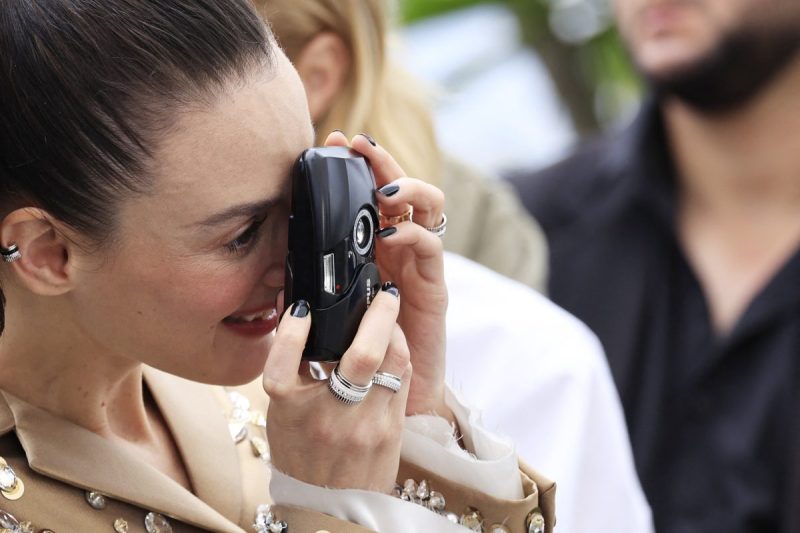
Then there’s photography, where the mechanism reaches remarkable economic sophistication. The global market for film cameras was worth about $1.1 billion in 2024, with 68 percent of enthusiasts under 35 reporting that they regularly shoot on film. Leica reproduced the M6 in 2024 “due to unprecedented demand from young photographers”; Pentax is developing a new mechanical film reflex camera. But the most revealing phenomenon is another: the trend of loading 35mm cameras with cinema film — the same Kodak Vision3 used to shoot Wes Anderson’s films — which requires development in ECN-2 chemistry, a process originally designed for the film industry available in very few labs worldwide, at costs enormously higher than standard C-41 development. The film roll is relatively inexpensive because it is respooled from 400-foot reels intended for movie cameras; however, development can cost double or triple, and if you do it at home, you find yourself managing the removal of the remjet — a black carbon coating on the back of the film — with results that even specialized blogs define as “a disaster.” It doesn’t matter: the appeal is being able to say you shoot on the same film as Hollywood. The product, here too, is not the photo: it’s the caption that accompanies it on Instagram.
In parallel, Gen Z has resurrected the digital compacts of the early 2000s – the so-called “digicams” – deliberately seeking low resolution, faded colors, flare, and the grain of CCD sensors from twenty years ago. The hashtag #digicam has accumulated hundreds of millions of views on TikTok. Canon PowerShot and Sony Cyber-shot 4-megapixel models are being sought on eBay, used market prices are rising, and the stated reason is the “authenticity” of the imperfect rendering — achieved by giving up all the image quality that thirty years of optical engineering have painstakingly won. The same logic applies to MiniDV: camcorders from the 90s and 2000s that recorded on digital tapes, now sought after for their “vintage look” and resold at prices that would have seemed absurd even when they were new.
Irony of history
The irony reaches its peak when viewed from a historical perspective. There was a moment, between the late 90s and early 2000s, when millions of families rushed to convert their VHS tapes to DVD, terrified by the idea that the magnetic tape would deteriorate and their holiday films would be lost forever. VHS-to-DVD conversion services became an industry. Twenty years later, the direction has exactly reversed: new tapes are bought from artists never listened to on tape, VHS of films available for free streaming are collected, MiniDV camcorders and 3-megapixel digital compacts are pursued. Digital, which was the salvation, has become the problem; analog, which was the problem, has become the salvation. But neither version is true: what has changed is not the quality of the medium, but the symbolic function we attribute to it, and that function is entirely determined by the need for identity that the market exploits.
However, there is a question that none of the analog nostalgics seem to ask with sufficient honesty, and that should be formulated in the most brutal way possible: who would really go back if going back meant never being able to move forward? Not analog as an aesthetic accessory to accompany digital, but analog as the only option. Who would really give up streaming to return to the time when if you wanted to watch a movie, you had to hope that the video store down the street had it, and if you arrived after eight in the evening, you found the shutter down and the alternative was the schedule of Rete 4? Who would really give up Spotify to return to a world where listening to an album meant physically finding it — in a store, if the store had it in stock, in the city where you lived, if the city where you lived had a record store? Who would really give up the smartphone camera to return to the time when the film cost money, development cost money, and you saw the holiday photos two weeks after returning, discovering that half were blurry and three had a finger in front of the lens? No one, of course. And the reason is simple: analog nostalgia works only to the extent that it is optional. Its appeal depends entirely on the existence of digital as a safety net. You shoot on cinema film because you know that if the roll turns out badly, you had the smartphone in your pocket, or you also shot with digital media. You buy the vinyl because you know that the album is still on Apple Music or Spotify. You go to the retreat without Wi-Fi because you know that in three days you’ll return to a world where Wi-Fi exists. Analog without digital is not a contemplative experience: it’s a disservice. And the difference between the two is exactly the price of the ticket.
The return to analog is a luxury
The industry that has grown around this performative renunciation has the same structure as the luxury wellness market. Eremito, a former 14th-century monastery in Umbria, offers off-grid candlelit stays – several hundred euros a night to sleep without Wi-Fi. Six Senses Bhutan keeps your phone during your stay in a Himalayan valley — a service that in the pre-smartphone era would have been called “no signal” and today costs between $500 and $3000. The photo of the dumbphone on the bedside table is posted on Instagram with the compositional care of a Kinfolk flat lay, and the hashtag #digitaldetox counts millions of posts — a contradiction so perfect that it seems like an artistic performance.
But the most relevant point is not the aesthetic hypocrisy. It’s the class structure that disconnection presupposes and that detox marketing renders invisible. Those who can afford to not have a smartphone are those who do not depend on it for work, for transportation, for banking operations. For a rider who uses the phone to receive orders, a $799 dumbphone is a dismissal. For a single mother coordinating after-school activities via WhatsApp, disconnection is a luxury as inaccessible as a Himalayan retreat. And those who can afford to shoot only on cinema film are those who do not need every photo to come out well on the first try — those who can afford waste as an aesthetic gesture. Disconnection is not a feasible choice for everyone. It is a choice that presupposes an infrastructure of privileges, and the invisibility of this infrastructure is an integral part of its functioning as a status marker.
Thorstein Veblen described the mechanism back in 1899, in The Theory of the Leisure Class, speaking of “conspicuous consumption.” The structure has remained the same, but the sign has inverted: the leisure class of 2025 does not flaunt an abundance of objects, it flaunts the ability to do without them. Elizabeth Currid-Halkett has called this mutation “inconspicuous consumption” (The Sum of Small Things, 2017): the spending of elites on markers of cultural capital that whisper status. Limited edition vinyl, the walnut wood turntable, the “new” Leica M6, the ECN-2 film developed in a specialized lab – these are markers that do not display money but taste, and that draw sharper social boundaries than any luxury car, because those who do not belong to the group do not even know that those boundaries exist. Disconnection and the return to analog are perhaps the purest example of inconspicuous consumption available on the market, because the product is literally an absence — and that absence positions you in the hierarchy with the precision with which, for the nineteenth-century bourgeoisie, the piano in the parlor that no one played did.
But there is an additional level. The attention economy does not monetize understanding or accuracy: it monetizes engagement. The more platforms optimize for engagement, the more the experience becomes toxic. The more toxic it becomes, the greater the demand for escape. And the greater the demand, the larger the market for those selling the antidote — the retreat, the dumbphone, the vinyl, the film, the podcast on “intentional living” recorded on a smartphone and distributed via streaming platform. Digital minimalism and analog nostalgia are not the opposite of platform capitalism: they are its premium product.
Our sad and desperate attempts to return to analog?
And the language in which we talk about these phenomena betrays the nature of the problem. “Detoxification” presupposes a “toxin,” and the medical metaphor performs a precise ideological operation: it transforms a structural problem into an individual pathology. If the system is toxic, the blame lies with your lack of discipline. And the cure can only be individual — a purchase, a lifestyle choice — because if the problem is yours, the solution is yours, and the market has the product for you, packaged in E Ink and walnut wood. The same goes for the return to analog: the solution to streaming that alienates you from music is not rethinking the business model of platforms but buying a €500 turntable and posting a photo of it with the caption “finally, real music.”
How sad and desperate, in the end, are our attempts to return to analog? Vinyls bought without a decent system to listen to them, CDs coming back into fashion among those who have never owned a player, cassettes purchased as ornaments by twenty-somethings for whom magnetic tape is as exotic as a typewriter, cinema films developed at a high price to obtain photos that will still end up scanned and posted on Instagram, 4-megapixel digicams bought on eBay to achieve the low resolution that any free filter could replicate, MiniDVs sought for a “vintage look” that is simply the appearance video had when it couldn’t look any better. And we end up routinely talking about all this, and boasting about it, on social media. The vinyl is photographed next to the cup of sought-after filtered coffee. The unboxing of the monthly package becomes a reel. The cassette is displayed on the shelf and immortalized for TikTok. The analog object does not exist until it has been digitized and shared: it is a ghost until it is photographed, and the (digital) photograph is the real product — not the record, not the film, not the tape.
And as long as the problem is framed in individual terms — “you need to disconnect,” “you need to go back to listening to music on a real medium,” “you need to shoot on film to rediscover slowness” — the solution will continue to be another product on the identity shelf. Another phone that does nothing, sold to those who can afford to do nothing with their phone. Another record that you won’t really listen to, printed on colored vinyl for those who need their library to communicate something precise. Another roll loaded with cinema film for those who need the act of photographing to say something about themselves.
The real question, one that no $799 dumbphone, no €500 turntable, and no old or new Leica can solve, is not how to disconnect or how to return to analog, but why connection has become so intolerable and culture so immaterial — and who benefits from the answer being sought in individual consumption rather than in structural change. Even writing an article like this, it must be said, is partly an identity gesture — the gesture of someone positioning themselves above both the dumbphone and the vinyl and the naive criticism of one and the other, in a spiral of self-awareness that does not exempt anyone, least of all the author, from the mechanism but only makes it slightly more difficult to pretend not to see it.