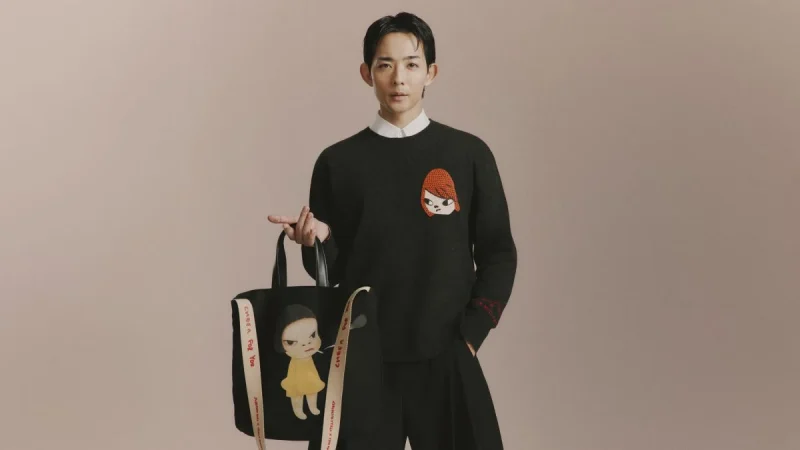
The first thing that strikes me, even though the interview is taking place online, is how much they laugh. There is an ease between them, a natural rapport. Yoshitomo Nara speaks in Japanese, an interpreter translates, while Stella McCartney jokingly tells me she is obsessed with him. They seem like old friends. Yet when they first collaborated, on a collection in 2021 (two more have followed, the latest, A Rock’n’Roll Forest, unveiled in Tokyo just days ago), they had never even spoken on the phone. “We worked with an ocean between us,” McCartney tells me. “We had never met, we had never even spoken.” She laughs. “I was so disappointed. All I wanted was to meet him.”
A Collaboration Born Across an Ocean
At the time, Nara had simply let her choose whichever works she liked. They finally met in Tokyo after the collection was finished, at the very boutique they are speaking to me from now. “Quite unusual,” McCartney admits. “But I couldn’t believe my luck. I know everyone in fashion has asked him to collaborate.” Then came the second collection, and now the third. Nara admits he hadn’t expected it. McCartney, on the other hand, had other ideas. “I was filming him and asked: shall we do another one? He said yes. I had it on camera. He couldn’t back out.” She laughs. “It’s one of the best things I’ve ever done in my life. Honestly.”
The Third Collection: Total Creative Freedom
This time, Nara gave her a completely free hand. “I was ready to tell her, ‘No, don’t do that’, if I needed to,” he says. “But I never did.” Between the first and second collections, he says, he had come to understand her approach to materials much better. “And I thought there was a really interesting way you could arrange my work. That’s why I was really looking forward to this collection with you.” Then he adds: “It didn’t feel like work.” For McCartney, that freedom came with its own pressure. “It was so open that I thought, oh my God, I can’t mess this up. I had to prove myself to him all over again.” The third collection, she felt, had to be the best yet. “Otherwise, why would anyone want it? Why would he want it?”
Limited Editions and Responsible Materials
The whole company was involved, from knitwear to shoes, denim to jersey. “Every day I’d walk down the corridor and there were Nara-san panels everywhere. It put everyone in a good mood.” As if to prove the point, McCartney is wearing the Cutie in the Puddle Knit as we speak. It is made from deadstock yarn, leftover stock from previous production runs. When she said she wanted to use it, the production team told her they could make two at most. No more. “And I said: perfect, then we’ll sell two.” And for now, there are just two. Any further pieces will be made to order, in very limited quantities, with a lead time of at least three weeks.
It’s not the only unusual piece in the collection. The Multi Crochet Scarf is a limited-edition, entirely handmade scarf, assembled from crochet patches featuring the faces of Nara’s characters. Each takes more than forty hours to make and is available by order, with the same minimum three-week wait. Then there are the Crocheted Faces: framed knitted pictures, measuring 50 by 50 centimetres, produced in two editions of ten, one for the United States and one for Japan. Each is sold individually as a collectible. The rest of the collection follows the same principles, using responsible materials throughout. The T-shirts, sweatshirts, jeans and corduroy trousers are made from GOTS-certified cotton; the sweaters and bomber jackets from RWS-certified wool. There is a GOTS-certified silk suit, a varsity jacket in FSC-certified viscose and a jacket in organic cotton velvet. Then come the bags, shoes and accessories, all entirely vegan.
Nara’s Little Girls: Innocence, Anger and a Punk Spirit
At the heart of the collection, as always, are Nara’s iconic little girls: the ones who never smile, look at you sideways, smoke and occasionally clutch a knife. McCartney picks up a bag from the latest collection. “It’s my absolute favourite. At one point I had to tell myself to stop adding things, but this one had to be there. Because everything about it is wrong. You’re not supposed to see a sweet, innocent little girl smoking. And yet she’s so fierce, so angry, so cool.” There is an innocence to Nara’s work, McCartney says, alongside a punk spirit and a proper ‘fuck you’. Something childlike, with a very serious message underneath. “As human beings, we’re not treating that little girl very well at the moment.”
I tell them that little girl reminds me of myself as a child. I was angry and free. I ask whether they know girls like that. “When I was a child, I had lots of them around me,” Nara says. McCartney thinks of herself, and of her daughter. “You have to be angry. The younger generation is frustrated. We want peace, we want the bombs to stop falling, we want animals to be treated with respect, we want to save the future for children. More than ever, young people have every right to be angry and to smoke a cigarette.” She turns to Nara. “Your work is so relevant right now.” “I hope so,” he replies, smiling.
From the Apple Orchards of Northern Japan to A Rock’n’Roll Forest
When I ask him about an album that has stayed with him, Nara turns to McCartney. “Your father’s.” “Correct answer!” He grew up in a small town in northern Japan, surrounded by apple orchards, in a region that produces around 60 per cent of the country’s apples. “I’m from the radio generation,” he says. Western music reached even this remote corner of Japan over the airwaves. He listened without understanding a word of the lyrics. Between middle school and high school, he began looking up the artists and buying their records. It was through the album covers that he discovered art. From the window of his childhood home, he could see the apple orchards, with the forest behind them. “This collection reminds me of that view.” McCartney looks at him, surprised. “Is that where Rock’n’Roll Forest comes from?” “Yes.” “How lovely.”
Music, Animals and the Power of Fashion
McCartney, who was born into music, tells me: “I was listening to it in my mother’s womb. My parents made music, I grew up in recording studios.” But when she works, she keeps it switched off. “If there’s music playing, I can only hear the music. And if someone puts on a bad song, I just can’t.” Classical music might be the exception, she admits. “It’s too big a part of my life.” I save the hardest question for last: can fashion and art still change anything? McCartney has never been afraid to take a stand for animals and the natural world. She tells me about a former colleague who once called to say that they had sold a million Falabellas, her best-known bag. “I didn’t think: wow, how much money. I thought: how many animal lives have we saved? A million bags means a million lives. And then: how many trees, how much water, how much electricity? How many hands didn’t have to kill a cow?”
For McCartney, what you wear says something about you, whether you intend it to or not. “If you walk around with a £200,000 crocodile bag, you’re saying something about yourself. If you wear fur, you’re saying something about yourself.” And if you walk down the street wearing something made by the two of them? “First, you’re very lucky. Second, you have excellent taste. Third, you share an idea.” Nara approaches the question from another angle. “A painting hangs in a gallery and people have to go and see it. It’s passive. If people don’t come, nothing happens.” Clothes, by contrast, leave the house. They travel around the world on the people who choose to wear them. That doesn’t mean he takes his own work lightly. When he paints, he says, he wrestles with himself and thinks about all kinds of social issues. “But I can only go as far as finishing the work. People like Stella take its magic, bring it into fashion and send it out into the world. That’s why I’m so grateful to have met her.”
Launch Dates and Where to Find the Stella McCartney x Yoshitomo Nara Collection
McCartney looks almost embarrassed. “I’m the lucky one. It’s mostly his work, really. I’m just the support act.” She hopes that whoever takes one of these pieces home will feel a little stronger, or a little happier. And that, a few generations from now, someone will still love them. That evening, A Rock’n’Roll Forest was celebrated at Tremolo, in Setagaya, transformed for the occasion into Nara’s rock’n’roll forest. The Stella McCartney x Yoshitomo Nara collection launches worldwide on 11 November. In Japan, it is available for exclusive pre-order at Isetan Shinjuku and the Stella McCartney boutique in Aoyama, ahead of its nationwide launch on 25 November. From 11 November to 8 December, Isetan The Space in Shinjuku hosts A Rock’n’Roll Forest, with installations featuring reclaimed furniture and works made from recyclable paper and cardboard, alongside exclusive pieces and collectible Nara stickers, with a different design each week.