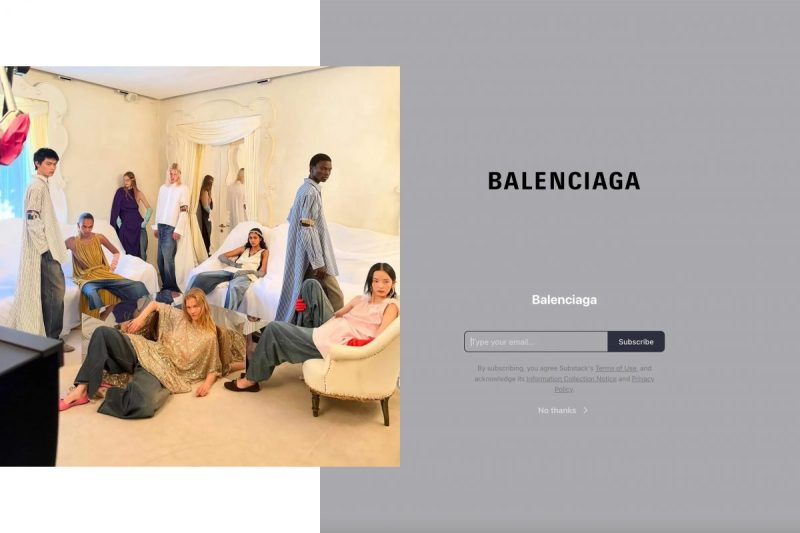
Balenciaga loves Substack so much that it has become the first fashion house to partner with it.
The house has been using the platform for some time: there it announced the arrival of Piccioli and also streams the fashion shows live.

And it is not a matter of style or creativity, but of a system that does not protect the independent brands most loved by critics.
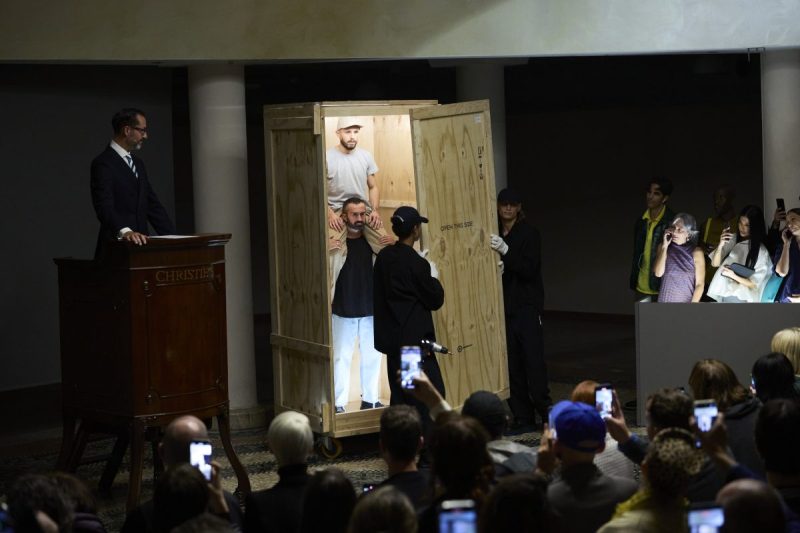
In May, the Milan Court declared the judicial liquidation of Sunnei. A news that today shakes public opinion: we are still talking about the brand that the ultimate fashion critic, Cathy Horyn, had dubbed the most original in Milan after Prada, the one that had made every runway show a viral performance and whose bar kept rising higher and higher. The last of these performances, last September, had seen Christie’s symbolically auction off the two founders (Loris Messina and Simone Rizzo) and the brand itself. Unfortunately, this prediction was not fulfilled: after the bow of the creative duo, no purchase was completed and the brand could not hold up. It would be misleading to consider this failure an isolated case: it is more the expression of the hype curse, which elevates to stellar success without being in any way a real indicator of financial health.
As the news of Sunnei’s liquidation spread, Coperni, the Parisian brand by Sébastien Meyer and Arnaud Vaillant (the one behind the spray dress worn by Bella Hadid and the Swipe Bag in all chemically realizable formats), ended up under judicial protection in Paris. A reorganization procedure decided by the court after months of missed payments by Tomorrow, the group that is its exclusive distributor and majority shareholder. According to Milano Finanza, despite continuous international growth, deprived of such resources, the brand found itself exposed to significant financial pressure capable of destabilizing the entire operation of the company. Judicial protection should allow the company to benefit from the protection provided by French law and continue to operate while waiting for a relaunch plan.
The most striking case in the last two years, however, remains that of Y/Project. The brand, founded by Yohan Serfaty and Gilles Elalouf and led for over a decade by Glenn Martens, had everything associated with success: the victory of the Grand Prize ANDAM, the finals at the prestigious LVMH Prize, collaborations with major international brands (first and foremost, the partnership with Jean Paul Gaultier), an artistic direction that became one of the most famous personalities in fashion, and a parade of celebrities ranging from Rihanna to Kanye West. On paper, the archetype of the independent brand that made it. In reality, a company that never managed to build a solid economic base beneath the surface of its aesthetic. In 2024, the company had only 24 employees, facing continuous growth (just the year before it had recorded sales of about 11 million euros). After Serfaty’s death and Martens’ exit from creative direction (already engaged with Diesel, and then becoming creative director at Maison Margiela), Y/Project sought a buyer for months without success until the definitive cessation of activity in early 2025.
The fates of Sunnei, Coperni, and Y/Project are different faces of the same coin: recognition and talent do not automatically translate into structure, margins, and profits. They are brands that critics and the public have loved, that celebrities have worn, that have managed to build a visual identity capable of influencing the taste of younger generations. An independent brand can be everywhere and simultaneously have a fragile balance sheet; this is the result of an illusory overexcitement (like that which accompanied Coperni’s show at Disneyland) that has emptied the term “iconic” of its meaning, and that says nothing about the real interest in purchasing from the public.
It is the same sword of Damocles that has fallen on Off-White, which after the death of Virgil Abloh in 2021 was nearing 400 million euros in revenue. A few years later, compounded by the exit from the Chinese market, direct online sales contracted between 20% and 50% in just one fiscal year, leading to LVMH’s sale to a fund specialized in struggling brands. It is not an isolated episode in its sector: even Supreme, another cornerstone name of luxury streetwear, was resold for a price lower than that paid for its acquisition just a few years earlier. The cooling of the hype-driven phenomenon, in these cases, does not concern a small emerging brand but an entire business model that for a decade has made scarcity and media desire its only commercial lever.
This apparent contradiction between hype and financial health depends on several factors. First, there is the dependence on a few external parties (whether a distributor, an investor, a luxury group), who can decide at any moment to enter or exit the capital. Coperni is the clearest example: the crisis does not arise from a decline in interest in the brand, but from the behavior of a single financial partner. Then, there is the speed of the hype cycle itself, which today consumes faster than any company can transform it into a stable economic structure in terms of margins, diversification of sales channels, and control of production costs. The moment a brand is everywhere on social media often does not coincide with the moment it has already built the fundamentals to survive successfully that peak of attention and the subsequent decline.
It is a balance that works only as long as those few interlocutors pay on time. Additionally, there is a particularly punitive working capital cycle (production and materials are paid for months in advance, while wholesale revenues often arrive after the season has already concluded) that becomes more severe precisely when a brand grows quickly, because growing means producing more before even collecting the corresponding revenues. There is the fixed cost of the fashion calendar: two or more collections a year, shows, campaigns, and prototypes to finance, regardless of actual revenue. It is a cost structure designed for realities with margins of large groups, not for small independent houses, and it is no coincidence that Y/Project ended up canceling a show precisely due to lack of liquidity: it is the symptom of a model that, beyond a certain growth threshold or without a solid financial partner, cannot sustain itself.
There is also a third element concerning the business model underlying most independent luxury brands. Large groups can rely on high-margin, low-volatility categories (fragrance, eyewear, licensed accessories) capable of financing fashion collections even at a loss. Independent brands, on the other hand, live almost exclusively on ready-to-wear and accessories sold to a network of multi-brand boutiques. A few months before declaring their departure, Messina and Rizzo had opened in Milan the first flagship concept store located on the ground floor of their headquarters, the so-called Palazzine Sunnei, publicly claiming the choice to open a store at a time when many were closing. Yet, that moment came a full 10 years after the brand’s founding: until that point, Sunnei had no physical store.
What should these cases teach us? That a change of perspective is necessary in how we read the industry. Gossip, chair changes, applauded runway shows, collaborations with celebrities, and pieces that become hard to find within a few hours say almost nothing about the solidity of a company. They say a lot about its ability to generate cultural attention, which is a real and valuable asset, but it is a different asset (sometimes even the opposite) from what is needed to stay afloat when conditions change and become unstable. Our attention as an audience is fickle, the purchasing potential as buyers is today shaky, the permeability to volatile microtrends is very high: Sunnei will likely not be the last name beloved by critics to conclude its run. In front of the next brand that seems to be everywhere, we should not ask ourselves if it is trendy, but who is holding it up and for how much longer they can do so.