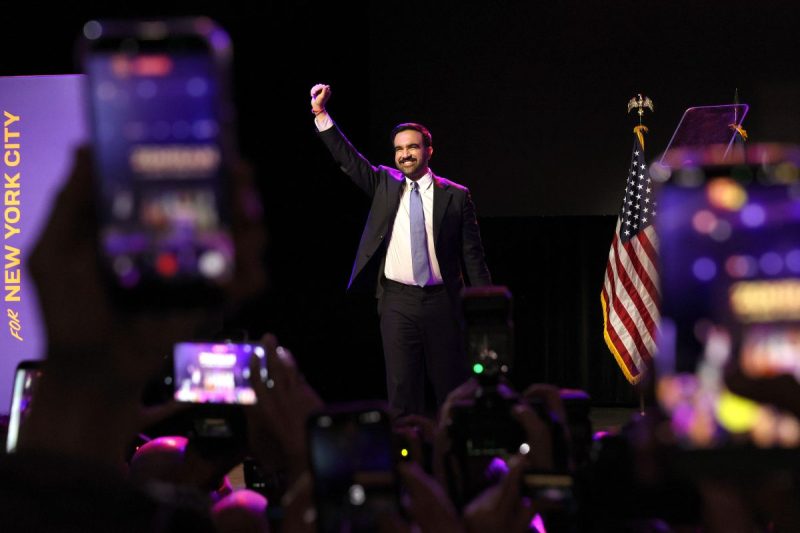
Mamdani has managed to block the rent increase for almost half of New York’s homes for at least a year.
"A historic victory for the tenants of New York," the mayor commented on the decision, formalized by the vote of the Rent Guidelines Board.

Judging by the contents of Leo XIV’s first encyclical on AI, Big Tech’s diplomatic efforts, after sending its envoys to the Vatican in recent weeks, appear to have left him largely indifferent.
There is a way to understand how profoundly artificial intelligence has reshaped the priorities of the tech industry: look at where it goes to lobby.
In recent months, major AI companies have taken their campaign of persuasion all the way to the Vatican, ahead of the first encyclical of Leo XIV. Representatives from Google, Meta, and Amazon arrived in the Vatican on April 29 to speak with the Pope about everything these companies are doing to ensure that artificial intelligences do not become yet another technological threat to children’s lives.
The meeting was brief, but it was followed by another, much longer one, held at the French Embassy to the Holy See, again to discuss the encyclical the Pope was still working on at the time.
The document, presented yesterday (Monday, May 25), is called Magnifica Humanitas, and in 245 points it sets out the Catholic Church’s official position on artificial intelligence.
Among other things, the encyclical states that “Never before has humanity had so much power over itself.”
The stakes are high: a papal encyclical does not have the force of law, but it has something laws often lack: moral authority over more than a billion faithful.
Sarah El Haïry, France’s High Commissioner for Childhood, told Politico that “the Pope’s encyclical could have an enormous impact, just as Leo XIII’s did in shaping a global vision for how to respond to the Industrial Revolution.”
Silicon Valley understood the message and showed up in the Vatican.
Structured in five chapters, Magnifica Humanitas offers a detailed reflection on the defense of the human person in the age of AI. Moving between comparisons with the Tower of Babel (the symbol of technological power without God) and Nehemiah and the walls of Jerusalem (symbols of reconstruction and unity), the text enters its third chapter: “Technique and Dominion: The Greatness of the Human Person in the Face of AI.”
Here it critiques the technocratic paradigm, which tends to reduce everything to an object of control, and warns against the narratives of transhumanism and posthumanism, which promise to free humanity from fragility through unlimited technological enhancement.
Against these visions, the Pope proposes the “more-than-human”: Christian grace and an integral humanism.
Chapter two reaffirms the Church’s theological foundations; chapter four speaks of “guarding the human” through three domains: truth, work, and freedom. In the fifth chapter, Leo XIV firmly condemns the normalization of war.
In any case, the encyclical positions the Church neither in technophobic condemnation nor in uncritical enthusiasm, but rather calls for discernment, shared responsibility, and the safeguarding of human dignity.
Leo XIV signaled from his very first address to the College of Cardinals that his pontificate would be centered on technology. The choice of name was, of course, not accidental. Leo XIII was the Pope of Catholic social doctrine, the one who, at the end of the 19th century, sought to articulate the Church’s response to the Industrial Revolution and defend the dignity of workers against the logic of emerging capitalism.
The new Leo has explicitly said he intends to do the same with AI. To reinforce this symbolic continuity, Magnifica Humanitas was released on the same day as the encyclical of his near namesake from the 1800s.
When Leo XIV presented the encyclical, he was joined by Christopher Olah, co-founder of Anthropic, the company that has refused to allow its technology to be used for mass surveillance or autonomous weapons systems, and which in recent months has developed a sustained relationship with the Vatican.
As early as January, Anthropic published a “constitution” defining the values underlying its flagship AI model. External contributors included two advisers to the Holy See: Bishop Paul Tighe, Secretary of the Dicastery for Culture and Education, and Father Brendan McGuire, a Silicon Valley priest and former engineer who advises the Vatican on technological matters.